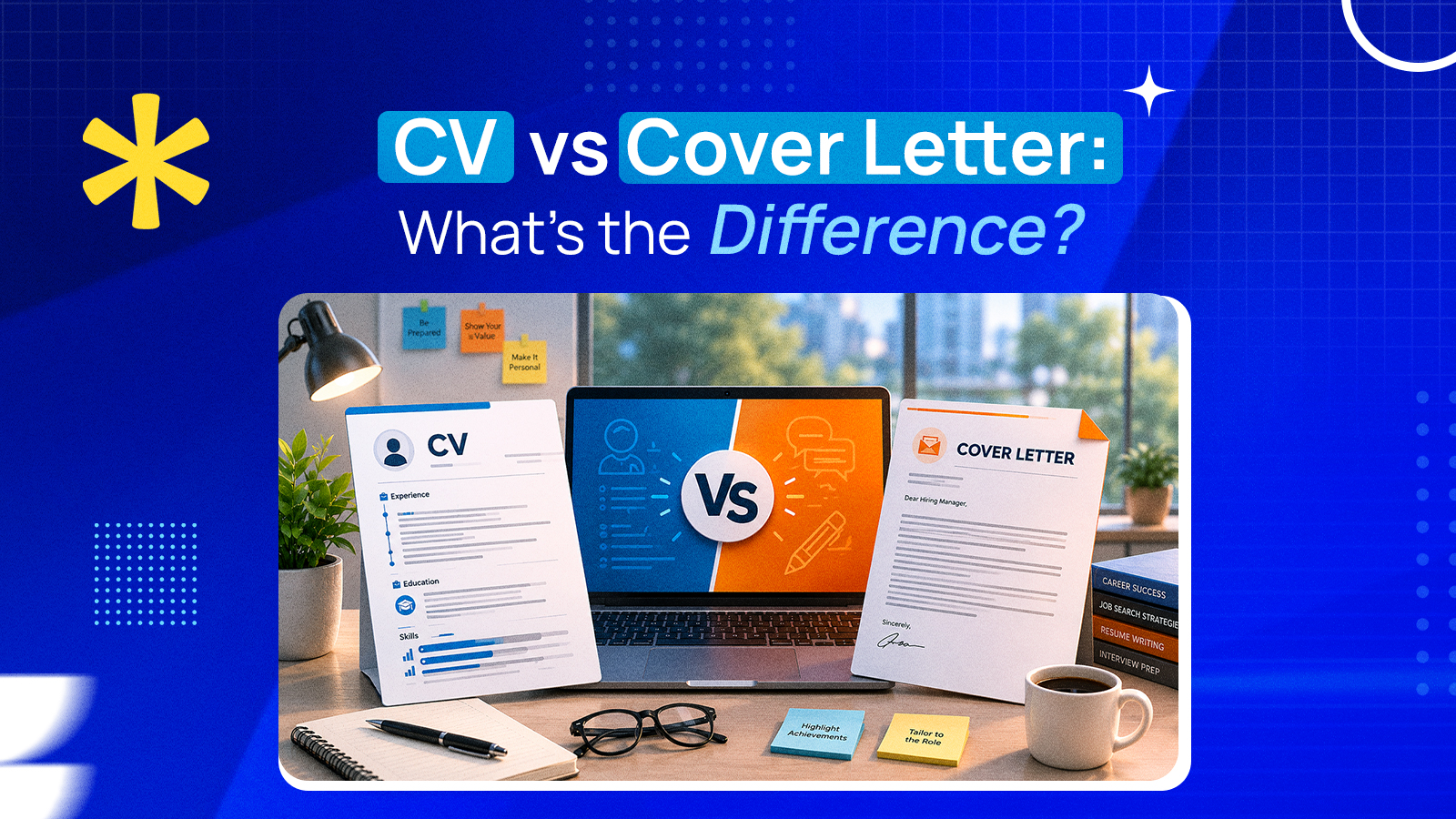
Imagine you've found a tech job that perfectly matches your skills, and you're finally ready to apply. Then you notice the employer asks for both a CV and a cover letter.
Do you need to submit both? Isn't your CV enough to explain your qualifications?
Questions like these are more common, especially among professionals applying for new opportunities or entering the job market for the first time.
A CV provides an overview of your education, work experience, skills, and achievements. At the same time, a cover letter allows you to explain your interest in the role and the value you can bring to the organization.
This is the reason why technical applicants must understand the difference between a CV vs cover letter. It can help avoid common application mistakes and present the qualifications in the way employers expect.
If you are trying to learn the purpose of each document to strengthen your application, you have come to the right place.
In this blog, we'll explain the differences between a CV and a cover letter, how they compare with a resume, when each should be used, and how to make them more effective for today's hiring process.
What Is a CV?
While applying for roles, you might have come across the word CV or Curriculum Vitae. Many job seekers assume that a CV is simply a longer version of a resume.
Even though both documents summarize your professional background, a CV is designed to present a more comprehensive record of your qualifications.
A Curriculum Vitae (CV) is a professional document that provides a detailed overview of your academic background, work experience, technical and professional skills, certifications, and more.
For technical professionals, a CV also provides space to showcase programming languages, technology stacks, and certifications. Depending on the industry and country, a CV may also include research experience, conferences, professional memberships, and licenses.
Employers use it to evaluate whether your education, experience, skills, and accomplishments align with the hiring requirements. They analyze and match it before moving you to the next stage of the hiring process.
What is the Purpose of a CV?
A CV serves as a factual record of your professional journey. It helps recruiters and hiring managers to quickly assess your qualifications, career progression, and suitability for a position.
A well-structured CV helps employers:
• Analyze your educational and professional background at a glance.
• Evaluate whether your experience matches the job requirements.
• Review your technical skills, certifications, and industry expertise.
• Identify career achievements that demonstrate your capabilities.
• Compare your qualifications with those of other applicants during the recruitment process.
What Is a Cover Letter?
A CV tells employers what you've done throughout your career. However, it doesn't always explain why you're interested in a particular role.
It also lacks the words to describe what makes you the right fit for the organization. That's where a cover letter becomes valuable.
In such cases, you need a cover letter. It is a personalized document that accompanies your job application. The letter introduces you to the employer, explains your interest in the position, and highlights your skills.
The document offers you the flexibility to explain how your experience and career goals align with the company's requirements. Unlike a CV, it is written specifically for each job application. The main aim is to create a compelling first impression on the employer.
What is the Purpose of a Cover Letter?
A cover letter allows tech applicants to add context that a CV cannot communicate. It helps employers understand your motivation, personality, and the unique value you can bring to the role.
A well-written cover letter helps you:
• Explain why you're applying for the position.
• Connect your experience to the employer's specific requirements.
• Highlight key achievements that are most relevant to the role.
• Demonstrate enthusiasm for the company and its mission.
• Showcase communication skills and professionalism before the interview stage.
Key Differences Between a CV and a Cover Letter
By now, it's clear that a CV and a cover letter are not interchangeable. They work together during the hiring process and serve a distinct purpose.
Recruiters often review both documents before deciding whether a candidate should move forward. Knowing the difference also helps you present your qualifications more effectively.
When you design each document correctly, it serves its intended purpose during the hiring process. You will be able to make your application more relevant and easier to evaluate.
Let's break down the key differences between CV vs cover letter, so you know exactly when and how each document should be used.
Content
The most noticeable difference between the CV and a cover letter is the content. Even though they are submitted together, they communicate different information to an employer.
A CV focuses on presenting your qualifications in a structured format. A cover letter explains how those qualifications make you a suitable candidate for a specific role.
CV
• Includes education, work experience, skills, certifications, projects, and achievements.
• Presents a complete overview of your professional background.
• Offers factual and structured information supported by dates and accomplishments.
• Helps recruiters analyze whether you are right for the job.
Cover Letter
• Helps introduce you to the employer.
• Explains why you're interested in the position and the organization.
• Highlights the experiences and accomplishments most relevant to the role.
• Adds context and personality that a CV cannot fully communicate.
Length
The length of a CV or cover letter depends on the purpose it serves during the hiring process. A CV is designed to provide detailed information, whereas a cover letter is expected to deliver a concise message.
CV
• Can be one to several pages long, depending on your experience and profession.
• May include your career progress, additional roles, certifications, publications, or projects.
Cover Letter
• Generally limited to one page.
• Focuses only on the qualifications that support the application.
• Should remain concise, engaging, and easy for recruiters to read.
Level of Customization
Every job applicant tries to present themselves in the best way. By adding a touch of personalization, they can show their skills.
CV
• Needs only minor updates for different positions.
• Relevant skills, projects, or achievements can be rearranged to match the job description.
• Core career information typically remains unchanged.
Cover Letter
• Should be written specifically for each employer and role.
• Addresses the company's requirements and demonstrates genuine interest.
• Reflects your understanding of the organization and how you can contribute.
Writing Style and Tone
The writing style of each document reflects its objective. One presents factual information, while the other creates a professional narrative around your qualifications.
CV
• Has a formal, structured, and achievement-focused writing style.
• Relies on bullet points, clear headings, and concise statements.
• Emphasizes measurable accomplishments rather than lengthy explanations.
Cover Letter
• Has a professional yet conversational tone.
• Explains your motivation and career goals naturally.
• Demonstrates communication skills while maintaining professionalism.
When Do Employers Ask for Each Document?
Application requirements vary across industries and organizations. Reading the job posting carefully ensures you submit the correct documents and avoid an incomplete application.
CV
• Is essential for nearly every professional job application.
• Serves as the primary document used to evaluate qualifications.
• Forms the foundation of the recruitment process.
Cover Letter
• May be optional or requested only for specific positions.
• Often expected for roles that value communication and motivation.
• Can strengthen your application when tailored to the employer.
How Do Recruiters Evaluate Them?
Recruiters review CVs and cover letters with different objectives in mind. Knowing what they look for can help you prepare both documents more effectively.
After evaluating your application, employers often assess your practical knowledge through the technical screening questions relevant to the current year. It makes interview preparation just as important as application preparation.
CV
• Companies check it first to confirm your qualifications and relevant experience.
• Evaluated to confirm career progression, technical skills, certifications, and measurable achievements.
• Helps recruiters decide whether a candidate meets the role's requirements.
Cover Letter
• Helps the company understand your motivation and interest in the role.
• Evaluated for communication skills, professionalism, and attention to detail.
• Helps recruiters determine how well your experience aligns with the employer's needs.
CV vs Resume vs Cover Letter
Have you ever walked into any recruitment discussion? You'll notice many recruiters use the common terms CV, resume, and cover letter interchangeably.
In reality, they are three different documents, each serving a distinct purpose in the hiring process. Submitting the wrong document or assuming they're identical can create confusion and even weaken your application.
The distinction becomes even more important when you are applying across different countries and industries.
For instance, many employers in the United States prefer resumes for most private-sector roles, while academic institutions and research organizations often request a CV. A reputable firm may want to check your cover letter. It will complement either document by explaining your interest in the position and why you are a great fit.
It is the primary reason why you must understand the difference between CV vs resume vs cover letter. Such choices will help you choose the right document for every application.
The following table explains the difference in detail:
| Feature | CV | Resume | Cover Letter |
| Primary Purpose | Provides a detailed record of your academic and professional background. | Summarizes your most relevant qualifications for a specific job. | Explains your interest in the position and why you're a strong candidate. |
| Length | One to several pages, depending on experience and profession. | Can be one page, or two pages for experienced professionals. | Only one page. |
| Content |
Education Work experience Skills Certifications Projects Publications Awards Achievements |
Relevant work experience Skills Education Accomplishments |
Motivation Relevant qualifications Career goals Alignment with the employer's needs. |
| Customization | Requires minor updates depending on the position. | Should be customized for every job application. | Should always be tailored to the specific employer and role. |
| Best Used For |
Academic Research Healthcare Government International positions |
Corporate jobs Private-sector jobs |
Submitted alongside a CV or resume. |
| Writing Style | Formal, factual, and achievement-focused. | Concise, targeted, and results-oriented. | Professional, persuasive, and conversational. |
| Primary Goal | Demonstrate your complete qualifications and career progression. | Show why you're a strong match for a specific role. | Create a personal connection and encourage the employer to review your CV or resume. |
CV and Cover Letter Examples
By now, you are clear about the differences between a cover letter vs resume vs CV. However, simply reading definitions won't help a job seeker form the right document for the application.
You need to know the right way to organize it into a professional and employer-friendly format. A well-written CV will highlight your qualifications in a structured manner. The cover letter will add context by explaining your interest in the role or contribution.
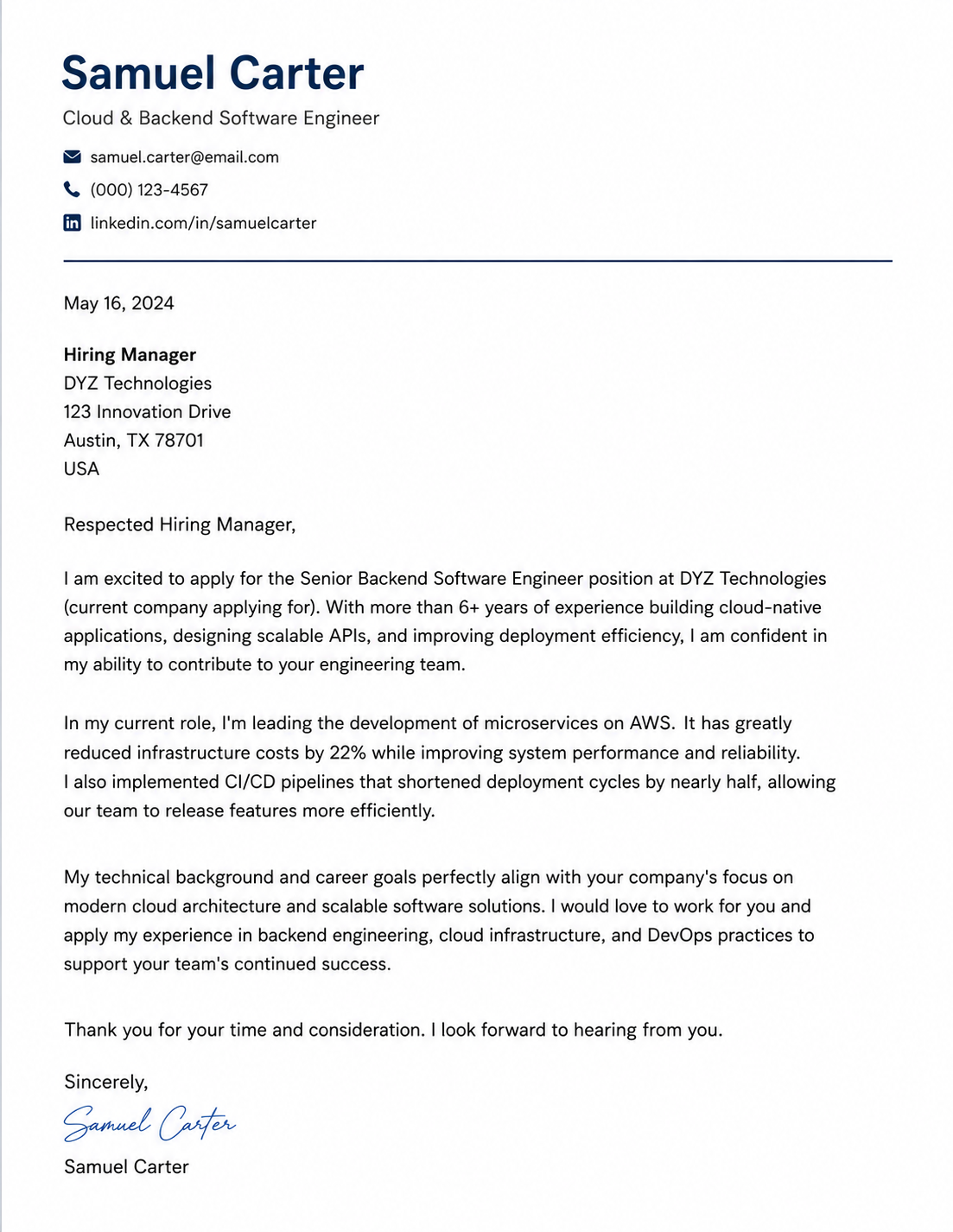
The following examples illustrate how each document should be presented for a job application:
Example of a Curriculum Vitae (CV):-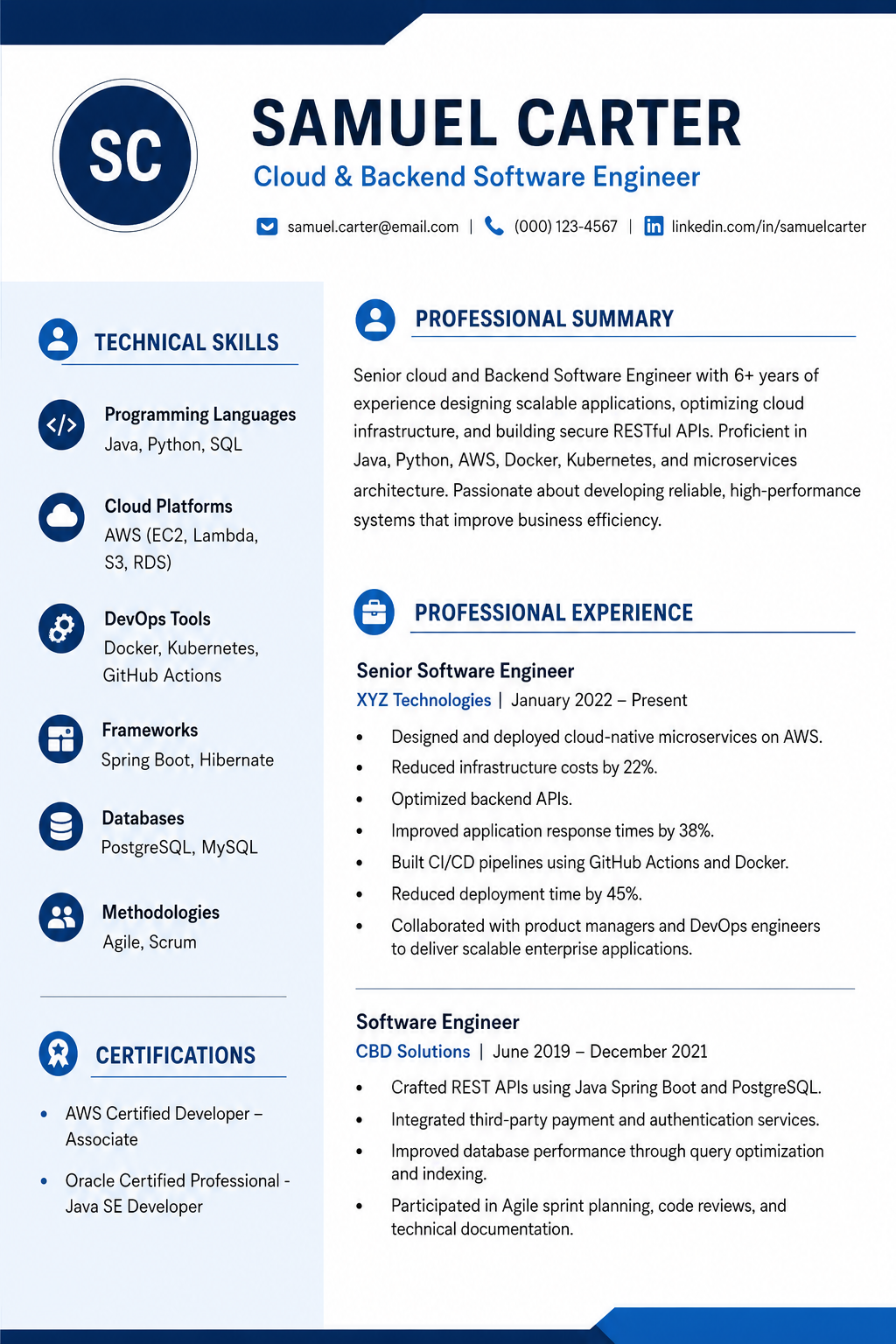
Example of a Cover Letter:-
How to Make Your CV and Cover Letter ATS-Friendly?
Submitting a well-written CV and cover letter is an essential part of the job application. In the current hiring market, employers conduct a thorough scan through the Applicant Tracking System (ATS).
Many medium and large organizations use it to organize, search, and rank applications before recruiters begin evaluating candidates.
A poorly formatted CV or an overly generic cover letter can still reduce the effectiveness of your application. It is therefore essential to follow a few ATS-friendly practices.
Such practices will ensure that both your documents are easy to read, properly organized, and aligned with the job you're applying for.
The following tips can help you make your CV ATS-friendly:
• Include keywords from the job description where they naturally fit.
• Use standard section headings such as professional experience, education, and Skills.
• Keep the formatting simple and avoid text boxes, graphics, or complex layouts.
• Highlight measurable achievements instead of only listing responsibilities.
• Include relevant technical skills, certifications, and tools that match the role.
How to Make Your Cover Letter ATS-Friendly?
After designing your CV, you need to work on your cover letter. You need to make it relevant, well-structured, and tailored to the position you are applying for.
• Personalize the letter for every job application.
• Naturally include the job title and important skills mentioned in the posting.
• Keep the content concise and focused on your most relevant qualifications.
• Prevent copying the same information from your CV.
• Use a professional structure with clear paragraphs and consistent formatting.
• Proofread properly to eliminate grammar and spelling errors before submitting.
Build Stronger Job Applications with the Right Documents
Every job applicant desires to get a job at a reputable firm for a sustainable career. The process becomes smoother when you know the difference between CV vs cover letter.
It helps you present your qualifications more effectively and submit the right document for every opportunity. The recruiter will be able to understand your intended purpose and evaluate your experience, skills, and motivation with greater clarity.
At Tech Disciples LLC, we help technical professionals strengthen their job search with practical career resources and professionally designed resume templates.
Our platform helps small and big companies build high-performing technical teams by finding good candidates. Whether you're refining your CV or exploring topics such as talent acquisition manager vs recruiter for scaling tech teams, our resources are designed to help you navigate today's competitive hiring landscape with confidence.
Start building a stronger application today and take the next step toward your technical career with Tech Disciples LLC.
FAQs:
1. Should You Send Both a CV and Cover Letter?
Yes, it is always better to send both the CV and cover letter when the client requests. Your CV provides a detailed overview of your qualifications, while a cover letter explains your interest in the role and highlights why you're a strong fit.
2. When Can You Skip the Cover Letter?
You can skip the cover letter if the employer clearly states that it isn't required, even if the online application doesn't provide an option to upload one. However, if you're applying for a competitive position or want to explain a career change or employment gap, submitting a tailored cover letter can add value to your application.
3. What File Format Should I Send My CV and Cover Letter In?
You should always send your CV and cover letter as per the employer's instructions. If no format is specified, PDF is usually the safest choice because it preserves your formatting across different devices.
4. How Often Should I Update My CV and Cover Letter?
Your CV should be updated whenever you gain new experience or complete a certification. You should also add the details when you complete a major project or develop new technical skills. The cover letter should be customized for every job application to reflect the employer's requirements.
5. Can I Use AI to Write My CV and Cover Letter?
Yes, you can use AI to write your CV. It is a good tool to generate writing ideas, improve grammar, or organize your resume content more effectively. Make sure to review and personalize AI-generated content to ensure it is truthful, relevant, and tailored to the position.
6. What Should I Do If I Don't Have Enough Experience to Write a Strong CV or Cover Letter?
Even if you don't have enough experience, try creating a good CV. Simply focus on the experience you do have. Mention the academic projects, internships, certifications, freelance work, volunteer activities, and technical portfolios. In your cover letter, explain your willingness to learn and enthusiasm for the role.
7. Can I Submit a CV Without a Cover Letter If I'm Applying Online?
Yes, if the employer doesn't require a cover letter, you can avoid adding the cover letter. However, when the option is available, a personalized cover letter can offer additional context about your experience, motivation, and suitability for the role.