Have you recently applied for a job and are waiting for the reply? Finding the right job often begins long before the interview. Employers go through hundreds of applications for a single opening.
It creates tough competition among technical job applications. So, what’s the solution?
You need to make your resume communicate your qualifications clearly, quickly, and professionally. Even qualified candidates can miss opportunities when important information is left out.
A plain curriculum vitae makes it difficult for recruiters and applicant tracking systems (ATS) to evaluate your true potential. Knowing the right things to add to a resume can make a significant difference in how employers perceive your application.
Every section should work together to highlight your qualifications, demonstrate your value, and show why you are the right fit for the position.
If you are trying to learn how to make the perfect resume, then you have come to the right place.
In this blog, we will discuss things to add to a resume, sections every employer expects, common mistakes to avoid, and a practical checklist to help you apply with confidence.
What Should You Put on a Resume?
Many technical professionals struggle to decide what to put in a resume beyond their job title and employment history.
You might focus heavily on listing technologies, while others spend too much space describing responsibilities without demonstrating the impact of their work. As a result, their resumes fail to communicate the value they can bring to an employer.
Many job seekers blame the applicant tracking system (ATS) when they do not hear back after applying. A common misconception is that most resumes are automatically rejected before a recruiter ever sees them.
However, the reality is quite different. ATS platforms help employers organize, search, and rank applications based on job requirements. They do not automatically eliminate the majority of resumes.
So what's the issue? Recent data says that around 62% of resumes are rejected because they fail to demonstrate the qualifications, relevance, or value required for the role.
The idea is simple: a stronger resume should have relevant data, not big chunks of content. For candidates applying to software development or other technical roles, every section should clearly communicate your expertise and business impact.
A complete resume should include:
• Professional contact information.
• A compelling professional profile.
• Relevant work experience with measurable achievements.
• Technical and workplace skills.
• Education and professional qualifications.
• Projects, certifications, or other sections that strengthen your application.
Essential Things to Add to Your Resume
By now, you have a basic idea that every section on your resume serves a purpose. Recruiters do not evaluate your application based on one qualification alone.
Instead, they look for a combination of relevant experience, technical expertise, measurable contributions, and career progression. It helps determine whether you meet the requirements of the role.
For technical positions, this evaluation happens even faster. Hiring managers often need to verify your core competencies and familiarity with specific technologies.
It helps them analyze the impact of your work before deciding whether to move you to the interview stage. Missing or incomplete sections can make them question even experienced candidates.
The following are the essential sections that form the foundation of an ATS-friendly resume:
Contact Information
Every resume must have contact details that are easy to find. Recruiters should be able to reach you immediately without searching through the document. Keep this section simple and professional.
• Full name
• Professional email address
• Phone number
• City and state (full address is no longer necessary).
• LinkedIn profile
• Portfolio, GitHub, or personal website (for technical roles).
Professional Summary
A strong resume summary gives recruiters a quick overview of who you are and what you bring to the role. Recruiters and hiring leaders often evaluate resumes differently.
Understanding the difference between a talent acquisition manager vs recruiter can help you tailor your resume to meet the expectations of everyone involved in the hiring process.
Your strong summary should include:
• Mention your years of experience.
• Highlight your area of expertise.
• Include two or three key technical skills.
• Reference one measurable accomplishment when possible.
• Align with the target job description.
Work Experience
You need to understand the importance of your work experience. It should demonstrate how you contributed to previous organizations. Recruiters want to understand the scope of your work and the results you achieved.
For each position, include:
• Job title.
• Company name.
• Employment dates.
• Key responsibilities.
• Quantifiable resume accomplishments and business impact.
• Relevant technologies or tools used.
Technical Skills
Hiring managers often scan this section before reading the rest of the resume. Organize your resume skills into categories so both recruiters and ATS software can quickly identify your expertise.
Consider grouping skills under headings such as:
• Programming languages.
• Frameworks and libraries.
• Cloud platforms
• and Databases.
• DevOps and automation tools.
• Development methodologies.
Education
Your education section provides the academic foundation for your experience. Keep it concise while including information that supports your qualifications.
Include:
• Degree or certification.
• Institution name.
• Graduation year (optional for experienced professionals).
• Relevant coursework (if applicable).
• Academic honors or distinctions.
Key Achievements
Recruiters are more interested in measurable impact than a list of duties. Strong resume achievements show how your work contributed to business goals and help distinguish your application from others.
Whenever possible, quantify your achievements by including:
• Revenue generated or costs reduced.
• Performance improvements.
• Time saved through automation.
• Customer or user growth.
• Project outcomes supported by measurable results.
Optional Resume Sections That Help You Stand Out
Many candidates assume recruiters only evaluate work experience and education. In reality, hiring decisions often come down to the evidence behind your expertise.
When two applicants have similar experience, recruiters naturally look for additional proof. It can immediately enhance the preference for a candidate who can deliver stronger results from day one.
Consider a cloud engineer applying for a role requiring AWS expertise. Both candidates mention cloud migration in their work experience, but one also includes AWS certifications and a GitHub portfolio.
The additional details effectively help validate technical knowledge before the interview even begins. It is why optional resume sections are so essential. It helps reinforce your credibility, showcase continuous learning, and demonstrate practical experience.
The following are the additional things that you can add to the resume:
Projects
Including relevant work in your resume's projects section is especially valuable for students, career changers, and technical professionals. It will demonstrate your hands-on experience. Projects show recruiters how you've applied your knowledge to solve real problems beyond your day-to-day responsibilities.
Consider including:
• The project title and a brief description.
• The technologies, frameworks, and tools used.
• Your specific contribution.
• Measurable outcomes or business impact.
• A GitHub repository, portfolio, or live demo (if available).
Certifications
Professional resume certifications demonstrate your commitment to continuous learning. It helps validate your specialized skills. They can also strengthen your profile when applying for technical positions.
Some good examples include:
• AWS Certified Solutions Architect
• Microsoft Azure certifications
• Google Professional Cloud certifications
• Certified Kubernetes Administrator (CKA)
• CompTIA Security+
• Certified ScrumMaster (CSM)
Awards or Publications
Mentioning industry recognition in the resume achievements section is again quite helpful. It shows how well you have contributed to the technical community. These accomplishments reinforce your credibility. You can smartly show that your expertise extends beyond your day-to-day responsibilities.
You may include:
• Industry awards or recognitions.
• Published technical articles or research.
• Conference presentations or speaking engagements.
• Open-source contributions.
• Patents or innovative solutions you've helped develop.
Things to avoid putting on a Resume
Adding more information does not always make a resume stronger. In fact, experienced recruiters often eliminate resumes that are cluttered with irrelevant details or generic content.
Such irrelevant stuff makes it harder to identify the candidate's qualifications. Every line on your resume should earn its place by supporting your suitability for the role.
To improve readability and keep the focus on your strengths, you should avoid including the following:
• Generic objective statements that say little about your qualifications or career value.
• Unrelated work experience that does not support the position you're applying for.
• Long paragraphs instead of achievement-focused bullet points.
• Personal information such as age, marital status, religion, or a full home address.
• Unverified technical skills or technologies you cannot discuss during an interview.
• Grammatical errors and spelling mistakes that create an unprofessional impression.
• Outdated certifications that no longer add value to your profile.
• Unprofessional email addresses or broken portfolio and GitHub links.
• Buzzwords without evidence, such as "hard-working" or "team player," unless they are supported by measurable accomplishments.
• Fancy graphics, tables, or excessive design elements that can reduce ATS compatibility.
Resume Checklist Before You Apply
It is a fact that even a well-written resume can lose its impact if it contains small errors or missing information. Hence, before submitting your application, review every section carefully.
Such practices will ensure that your resume reflects your qualifications. It will align with the position you're applying for. A few extra minutes of proofreading and refinement can significantly improve your chances of getting shortlisted.
The following is the resume checklist that you need to double-check:
• Accurate and up-to-date contact information.
• Professional email address and working phone number.
• Updated LinkedIn profile, portfolio, or GitHub links.
• Resume tailored to the target job description.
• Strong professional summary aligned with the role.
• Relevant work experience listed in reverse chronological order.
• Measurable achievements included wherever possible.
• Technical skills relevant to the position.
• Education details are complete and accurate.
• Projects included if they strengthen your application.
• Certifications were added where they demonstrate specialized expertise.
• Consistent formatting, fonts, and spacing throughout the document.
• Clear section headings that improve readability.
• No spelling, grammar, or punctuation errors.
• No outdated, irrelevant, or duplicate information.
• File saved in the format requested by the employer.
• Resume reviewed one final time before submission.
ATS-Friendly Resume Example
Many job seekers assume that creating an ATS-friendly resume means adding as many keywords as possible. In reality, applicant tracking systems are designed to organize and parse information.
The final decision is always made by the recruiters. Hence, the best resume should strike a balance between ATS compatibility and readability. You can ensure that by using a clear structure, standard headings, and relevant, role-specific information.
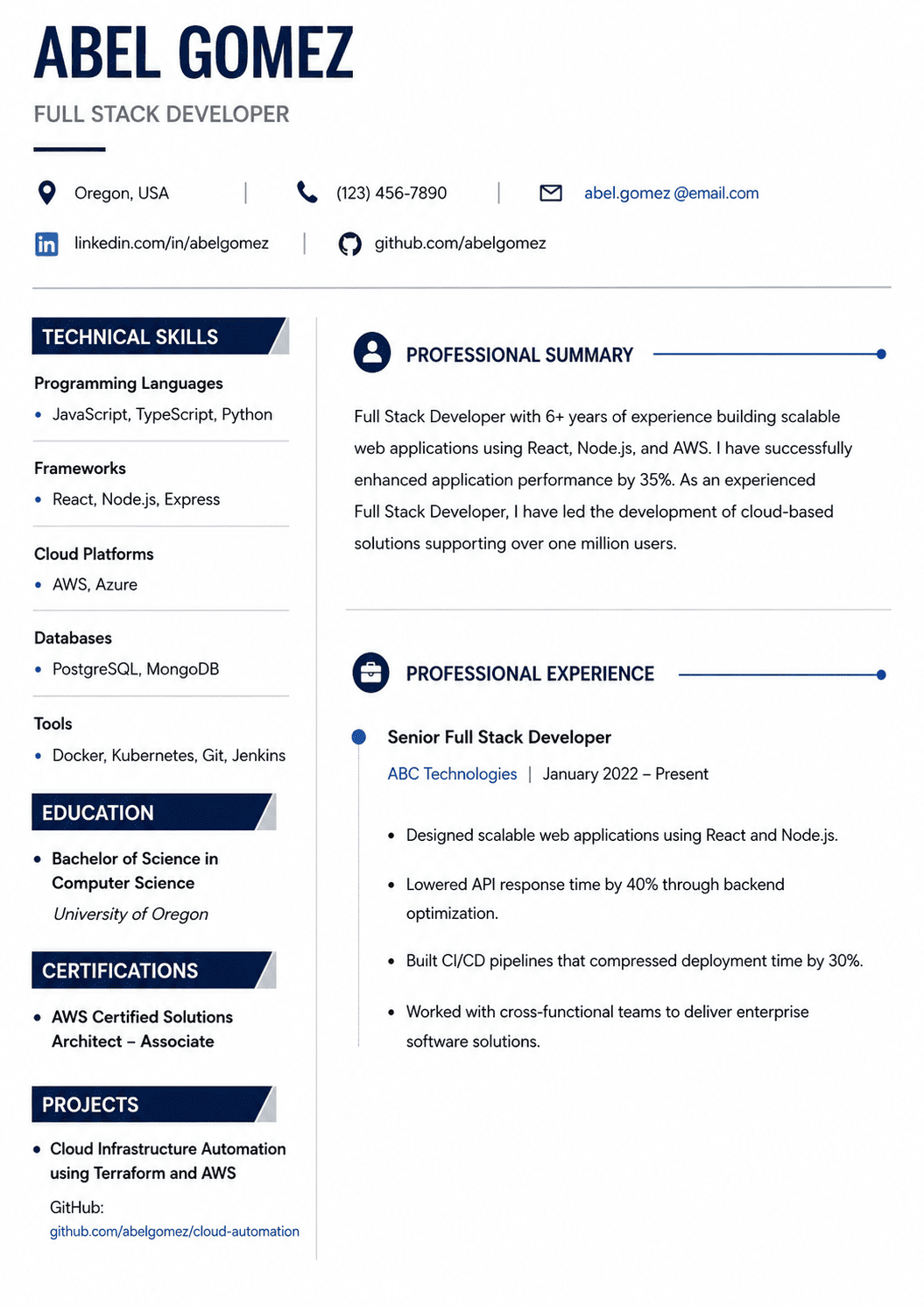
Here is an ATS-friendly resume example:
Build Stronger Technical Teams With Tech Disciples LLC
Knowing the right things to add to a resume can make the difference between being overlooked and getting invited for an interview. From presenting measurable achievements to showcasing technical skills, every section should demonstrate your value.
At Tech Disciples LLC, we help companies connect with talented candidates. Whether you want an experienced software engineer, cloud specialist, or just a beginner, our team understands what employers expect from a competitive resume.
You can explore our resources to better understand what a hiring manager does in tech hiring and gain practical insights. We can help you strengthen your recruitment strategy and make more informed hiring decisions.
Partner with Tech Disciples LLC today to connect with exceptional technical talent and build high-performing teams with confidence.
FAQs:
1. What are the most important things to add to a resume?
The most important sections you need to include in your resume include your contact information, professional summary, work experience, relevant skills, education, and measurable achievements. If you're applying for technical roles, include programming languages, frameworks, cloud platforms, and certifications.
2. How can I make my resume stand out to recruiters?
You can make your resume stand out to recruiters by focusing on relevance rather than length. You should customize your resume to the job description. Try to highlight measurable achievements and organize information using clear headings.
3. Should I customize my resume for every job application?
Yes, you should tailor your resume to help recruiters quickly identify your qualifications that match the role. Try adjusting your professional summary, relevant experience, skills, and keywords to align with the job description.
4. What should I include on a resume if I have no work experience?
You should include all the critical information in your resume. If you're a student or career changer, you should focus on projects, internships, freelance work, and certifications. For technology roles, include GitHub repositories, portfolio projects, hackathons, or open-source contributions.
5. How many skills should I list on my resume?
There is no fixed number to list on your resume. You should remember that quality is more important than quantity. Most resumes benefit from listing 10 to 15 relevant skills that directly relate to the position.
6. What are the biggest resume mistakes to avoid?
The biggest resume mistakes to avoid are submitting a generic resume or listing responsibilities without measurable results. You should also avoid including outdated or irrelevant information. Technical candidates should also avoid overstating skills.
7. How do I know if my resume is ATS-friendly?
You can know that your resume is ATS-friendly by organizing it properly. Try using standard section headings, consistent formatting, readable fonts, and keywords that accurately reflect the job description.