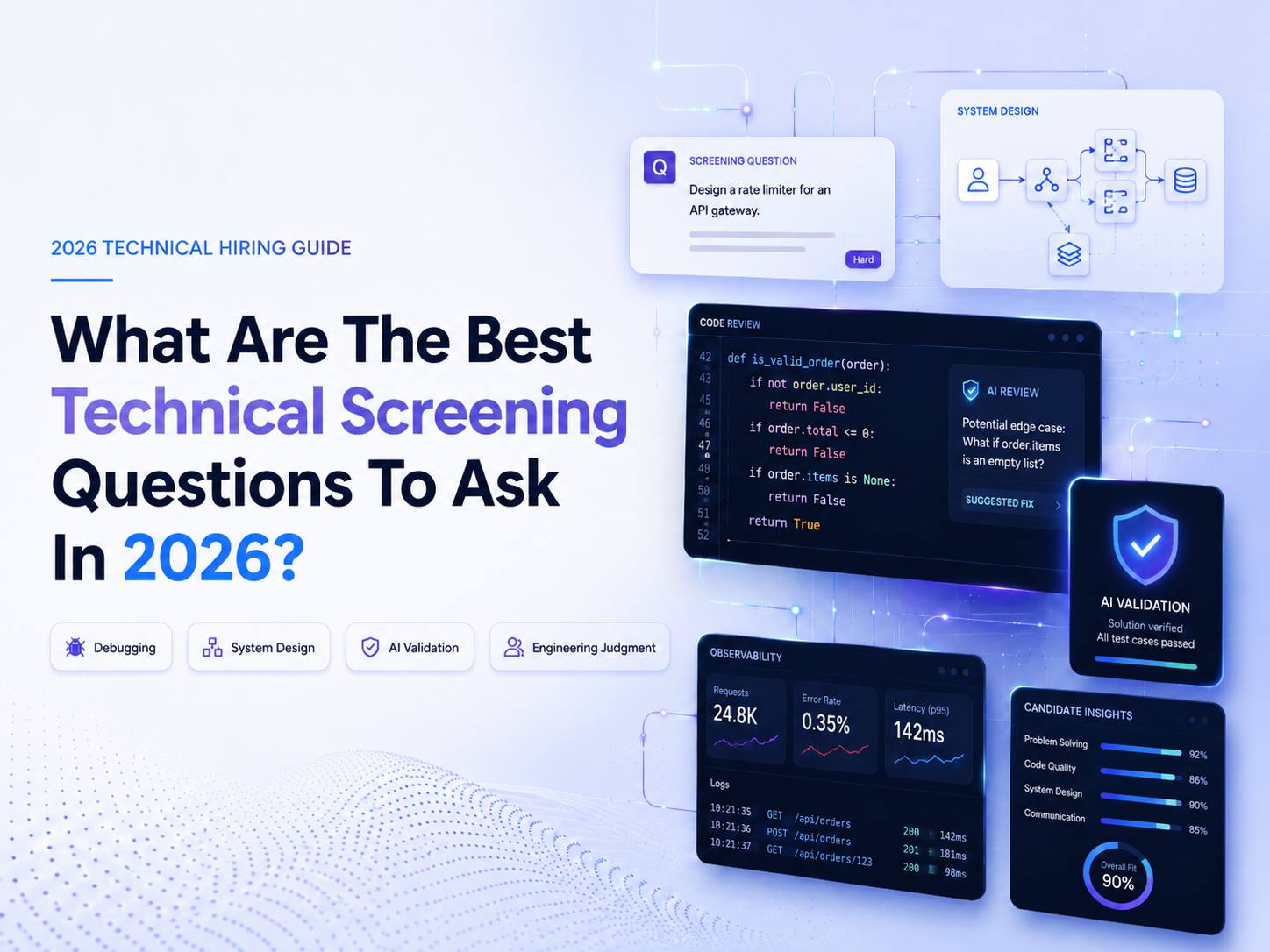
Hiring technical talent has become harder in the AI era. Many candidates can now solve coding interview questions using AI-assisted coding tools. But this does not mean they can debug a production system or audit AI-generated code.
However, many still struggle with edge cases, production debugging, and engineering judgment under pressure. Hiring managers now face a harder challenge: identifying genuine engineering talent. A good showing in the interview is no longer the issue.
Technical screenings now focus more on engineering judgment and less on abstract problems. Engineers need to demonstrate proficiency in system design, AI, and debugging during an interview.
Additionally, code verification, maintainability, communication, and ownership should be assessed. The ultimate list of technical interview questions is here. Find the best ones for software engineers, AI engineers, DevOps, backend, and full-stack roles.
Why Have Technical Screening Questions Changed in 2026?
Technical hiring changed because software development changed. AI-assisted coding tools now generate code, tests, and infrastructure scripts within seconds. That speed improves productivity, but it also creates new hiring risks. AI tools can generate working code while still introducing security, maintainability, or scalability risks.
Employers found a fatal flaw with the traditional coding interview. Abstract whiteboard brain teasers weed out some of the best engineers. And it's bad to let through weak engineers who know the solutions by heart.
Accordingly, companies are shifting their focus to practical engineering skills, away from memorization of algorithms. Companies are also re-evaluating compensation benchmarks as AI reshapes engineering responsibilities and hiring expectations. Many hiring teams now rely on updated software engineering salary data to stay competitive in technical recruiting.
Now managers are asking about code review quality, debugger skills, and the rationale for the design. Understanding of AI workflows and effective communication are now emphasized. In the end, assessing these dimensions provides a much better picture of the work an engineer does in practice.
What Skills Should A Modern Technical Screen Actually Measure?
Today, the technical screening checks candidate skills on production thinking, problem-solving, and communication. Modern technical screens evaluate coding fundamentals, debugging ability, maintainability thinking, AI readiness, security awareness, and scalability reasoning. Candidates should also demonstrate security awareness, scalability reasoning, and engineering ownership.
Many CTOs now view AI fluency as a supporting skill instead of a replacement for engineering fundamentals. Many candidates get lost during production incidents and can't articulate the code produced by an AI. In addition, they can't detect a hallucination. This is the very operational risk that modern questions try to catch when testing reasoning.
What Core Coding, Debugging, and Code Quality Questions Should You Ask?
Today's best engineering questions feel like actual on-the-job problems. The questions have moved on from "abstract algorithm puzzles" to what kind of system debugging and optimization work they can do. Employers now prioritize engineers who can build, maintain, and scale reliable production systems.
Which Coding Fundamentals Questions Reveal Real Problem-Solving Instead Of Memorization?
These interview questions break from the standard, rote pattern. They check your thought process and scalability readiness, assessing your ability to think like an engineer.
- How would you process a massive dataset that cannot fit into memory?
- How would you detect duplicate events in a distributed event stream?
- How would you optimize a slow API endpoint serving millions of requests?
Many SaaS platforms encounter API bottlenecks caused by inefficient queries, missing indexes, or poorly implemented caching layers.
- How would you design a retry mechanism for unreliable external APIs?
- How would you prevent race conditions in concurrent systems?
Which Debugging And Legacy-Code Questions Reflect Day-To-Day Engineering Work?
Puzzle-rich interview questions don't predict engineering ability. Debugging questions, however, are much better. Most engineers spend most of their time fixing problems in production systems, anyway.
- A production service slows down after deployment. How would you investigate?
- How would you debug intermittent failures that cannot be reproduced locally?
Real-world debugging often involves distributed systems, stale caches, cloud infrastructure, or inconsistent environments. Experienced backend engineers typically narrow uncertainty systematically using logs, metrics, and tracing tools.
- How would you safely refactor poorly documented legacy code?
Legacy code remains a major challenge across enterprise engineering teams. High-performing teams often discuss incremental refactoring, rollback safety, and testing discipline.
- What would you verify before removing old production code?
- A memory leak appears only under high traffic. How would you investigate it?
Which Code Quality Questions Test Maintainability, Testing, And Observability?
The importance of maintainability has risen considerably among modern engineering teams. Poor maintenance is contributing to slower feature velocity and higher operational risk.
• What makes code maintainable over time?
• How do you decide between unit testing and integration testing?
• What logs, metrics, and alerts would you add to a production service?
• How would you conduct a code review for a complex pull request?
To achieve high-quality engineering, teams rely on code reviews. It helps ensure software robustness. It is also used for security policy enforcement. In the long run, the architecture itself is preserved.
• How would you reduce technical debt without slowing product delivery?
What AI Workflow Questions Should You Ask Technical Candidates in 2026?
AI tools now influence almost every stage of modern software development. As a result, employers must evaluate whether candidates can use AI responsibly without compromising software quality or security.
Traditional coding interviews rarely reveal whether engineers can safely work with AI-generated outputs in production environments. The questions should assess the skills required in judgment and validation. In the long run, the questions should ascertain operational awareness.
How Can You Test Whether Candidates Can Validate AI-Generated Code?
Employers use these technical assessment questions to evaluate how candidates validate AI-generated outputs. Employers are looking to see whether candidates use AI responsibly. This ensures they use the AI without compromising software quality.
• How would you verify that AI-generated code is secure and correct?
• What warning signs suggest AI-generated code contains hallucinations or security flaws?
AI-assisted coding has caused outages to various engineering teams. These issues included hallucinated APIs and insecure authentication code. Some teams mentioned security and infrastructure misconfigurations.
• How would you test AI-generated SQL queries before production deployment?
• How would you ensure AI-generated infrastructure scripts follow engineering standards?
• When should developers avoid AI-generated code entirely?
How Can You Tell If Candidates Understand AI Risks, Security, And Edge Cases?
With modern AI workflows, new operational and security risks are emerging. Technical candidates must know them inside and out.
• What security risks can AI-assisted coding introduce into software systems?
• How would you prevent sensitive company data from entering public AI systems?
Now, almost every company has begun publicly restricting the use of AI. Many worry about the secret code leaking into the public. Also, the internal infrastructure will be completely exposed.
• What edge cases commonly break AI-generated implementations?
• How would you safely validate AI-generated infrastructure automation?
• What risks emerge when junior engineers over-rely on AI coding tools?
How Can You Separate AI Fluency From Weak Fundamentals?
Strong engineering candidates should demonstrate reasoning ability beyond generated outputs.
• Can the candidate explain why an AI-generated solution works?
• Can the candidate identify scalability bottlenecks?
• Can the candidate improve maintainability and readability?
• Can the candidate explain engineering trade-offs clearly?
• Can the candidate debug AI-generated mistakes independently?
Many hiring managers would agree that self-debugging ability is one of the best measures of what a good present-day engineer is. Developers preparing for AI-era technical interviews often use engineering-focused career platforms to better understand and find in-demand technical roles.
What System Design and Architecture Questions Best Predict Senior Engineering Performance?
System design questions are excellent evaluators. They will expose a candidate's understanding of scale and reliability. And will test the candidate's comprehension of resilience and operational complexity.
Which Scalability And Reliability Questions Should Backend, Platform, Or Full-Stack Candidates Answer?
These questions evaluate architectural thinking and production readiness.
• How would you scale a notification platform serving millions of users?
High-scale systems must handle retries, queue backpressure, rate limits, and regional failures reliably.
• How would you design a highly available API service?
• How would you reduce database bottlenecks in a growing application?
• How would you handle traffic spikes during major product launches?
• How would you design observability for distributed systems?
Which RAG, Vector Database, And AI Architecture Questions Should AI/ML Candidates Answer?
AI engineering interviews have shifted away from pure machine learning theory toward deployment reliability, production operations, and AI system governance. Deployment and production operations are what matter most to the teams now.
• How would you design a Retrieval-Augmented Generation pipeline?
• What trade-offs exist between vector databases and traditional search systems?
• How would you reduce hallucinations in enterprise AI applications?
Businesses are spending more money on validation layers and RAG pipelines. In addition, they are rolling out human review processes. These safeguards help organizations significantly reduce hallucination risk in enterprise AI systems.
• How would you evaluate embedding quality for semantic search?
• How would you secure enterprise AI systems handling sensitive data?
Which Trade-Off Questions Reveal Engineering Judgment?
Engineering judgment often predicts senior-level success better than memorized coding interview questions.
• When should simplicity take priority over scalability?
• When is microservices architecture the wrong choice?
• What trade-offs exist between consistency and availability?
• When should teams build internally versus buy external tools?
• How should teams balance feature velocity against technical debt?
What Scenario-Based Questions Reveal Ambiguity, Communication, and Ownership?
Engineering work rarely comes with perfect requirements. Strong engineers communicate clearly, clarify ambiguity, and take ownership during high-pressure situations.
Which Questions Show How Candidates Handle Vague Requirements?
These software developer interview questions test communication skills and business acumen.
• A stakeholder asks for a “faster dashboard.” What questions would you ask first?
• Product requirements conflict with infrastructure limitations. How would you respond?
• A feature request lacks measurable business goals. What would you do?
• How would you estimate work with incomplete technical information?
• A project changes direction midway through development. How would you adapt?
Which Production Incident Questions Reveal Troubleshooting And Accountability?
Incident-management questions often reveal operational maturity and engineering ownership.
• How would you lead a production outage investigation?
Strong engineers prioritize service restoration, calm communication, and systematic root-cause analysis during incidents.
• How would you communicate during a critical system incident?
• What would you do after discovering data corruption in production?
• How would you conduct a blameless postmortem?
• How would you prevent repeated outages after an incident?
Which Stakeholder Communication Questions Reveal Business Impact?
How are excellent engineers identified? They focus on much more than just how to implement something. They ensure their technical decisions have a business impact.
• How would you explain technical debt to non-technical executives?
• How would you communicate engineering delays to stakeholders?
• How would you push back against unrealistic timelines?
• How would you justify infrastructure investment to finance leadership?
• How would you prioritize competing requests from multiple departments?
How Should Employers Structure, Score, and Improve Technical Screening?
Strong senior engineers typically rely on structured decision-making rather than intuition alone. Employers must overhaul their hiring processes. One way they should do so is by clearly defining their required competencies and establishing consistent scorecards. Employers should also ensure that the technical interview questions reflect the job's duties.
Many puzzle-heavy technical interviews weeded out strong, practical engineers. Since then, some companies have rebuilt their entire technical interview process. Structured interviews now improve hiring fairness, consistency, and long-term hiring quality.
Mature organizations prioritize evaluating candidates across multiple competency levels. A tough screen will test both basic technical and soft skills. It also tests for modern skillsets like AI fluency, maintainability reasoning, and systems design. Modern technical interviews should reflect real engineering work instead of artificial interview exercises.
Tech Disciples LLC — Building Stronger Tech Careers and Smarter Engineering Teams.
The best technical screening questions in 2026 do more than test coding ability. These questions reflect problem-solving, debugging, and communication skills.
Most importantly, it captures how an engineer validates AI code and how engineers respond during high-pressure production incidents. Companies need to evolve their technical screening processes now to build stronger teams and avoid hiring mistakes to succeed in the AI era.
Tech Disciples LLC helps companies modernize technical hiring for the AI era through smarter screening strategies and stronger engineering recruitment. We specialize in improving technical interview questions. Team with us to create a vastly superior engineering recruiting process.
What Are The Best Technical Screening Questions To Ask: FAQs
1. What is the difference between a technical screening and a technical interview?
A technical screening checks baseline technical skills. Technical interviews are not merely a checklist of skills. Technical interviews assess one's engineering depth and design capabilities. Also, technical interviews measure one's debugging skills, communication, and role-specific knowledge.
2. How long should a technical screening call be?
Most technical screening calls last 30–60 minutes depending on role complexity, seniority level, and whether the assessment includes coding, debugging, or system design evaluation.
3. Who should conduct the technical screening?
Recruiters should handle early qualification. Skilled professionals must conduct the technical screening rounds. Technical screening calls should be handled by experienced engineers or by hiring managers. Such individuals are well-qualified to judge solutions in architecture, debugging, and code.
4. Should companies share the screening format with candidates in advance?
Yes. Sharing the interview format enhances candidate experience. It reduces the candidates' stress and provides greater equity for all candidates. In addition, the candidates can be prepared with suitable technical questions.
5. How many technical screening questions should employers ask?
The best technical screens have 5-10 signal questions. The most effective technical screens focus heavily on reasoning, debugging ability, communication, and engineering judgment. The questions assess communication skills and general engineering intuition.
6. How can non-technical recruiters screen technical candidates more effectively?
Recruiters should rely on structured scorecards, role-specific rubrics, and input from engineering leaders during technical candidate evaluations. Role-specific rubrics are also necessary to evaluate candidates. The engineering leadership teams should take part in creating these.
7. Should technical screens be different for remote roles?
Yes. Remote technical screens need their own set of requirements. Should be able to test: A sync communication, documentation, collaboration, ownership, and troubleshooting.
8. How can employers make technical screening fairer for non-traditional candidates?
It is now time to move away from trivia-filled interview tests. Ensure that focus evaluations focus on engineering skills and use the hardest possible criterion. Candidates should be given at least two methods to test all of these attributes.