In the rapidly evolving digital era, tech professionals are the backbone of innovation and business growth across industries. Every organization now needs a tech expert to streamline operations and drive technological advancements through coding and frameworks.
But often, business owners struggle to hire tech talent without a technical background. In fact, majority of recruiting managers are struggling to find qualified professionals from the tech sector.
Since they judge candidates based on resumes, job titles, and surface-level interviews, they often end up hiring the wrong people or those who don't fit the role. Such a mistake can significantly increase hiring costs.
It is therefore essential to follow a structured hiring process to hire the right candidate. Communicate clearly with candidates to assess their problem-solving skills and the quality of their past work.
Once you incorporate such strategies, hiring technical professionals becomes easy, even for non-technical people.
In this blog, you will learn the practical frameworks that confidently help you evaluate developers, data scientists, or engineers. It will also discuss the mistakes that non-technical founders should avoid while hiring tech experts.
The difficulty comes from the gap between business understanding and engineering talent acquisition. By utilizing sourcing techniques on GitHub and designing hands-on tasks, you can assess their abilities.
Why is Hiring Tech Talent So Difficult for Non-Technical Business Owners?
Hiring tech talent may seem straightforward at first, but when you enter the real-world recruitment, it becomes complex. Non-technical founders may understand product vision clearly. However, you may struggle to evaluate who can actually build the product.
The difficulty comes from the gap between business understanding and engineering talent acquisition. By utilizing sourcing techniques on GitHub and designing hands-on tasks, you can assess their abilities.
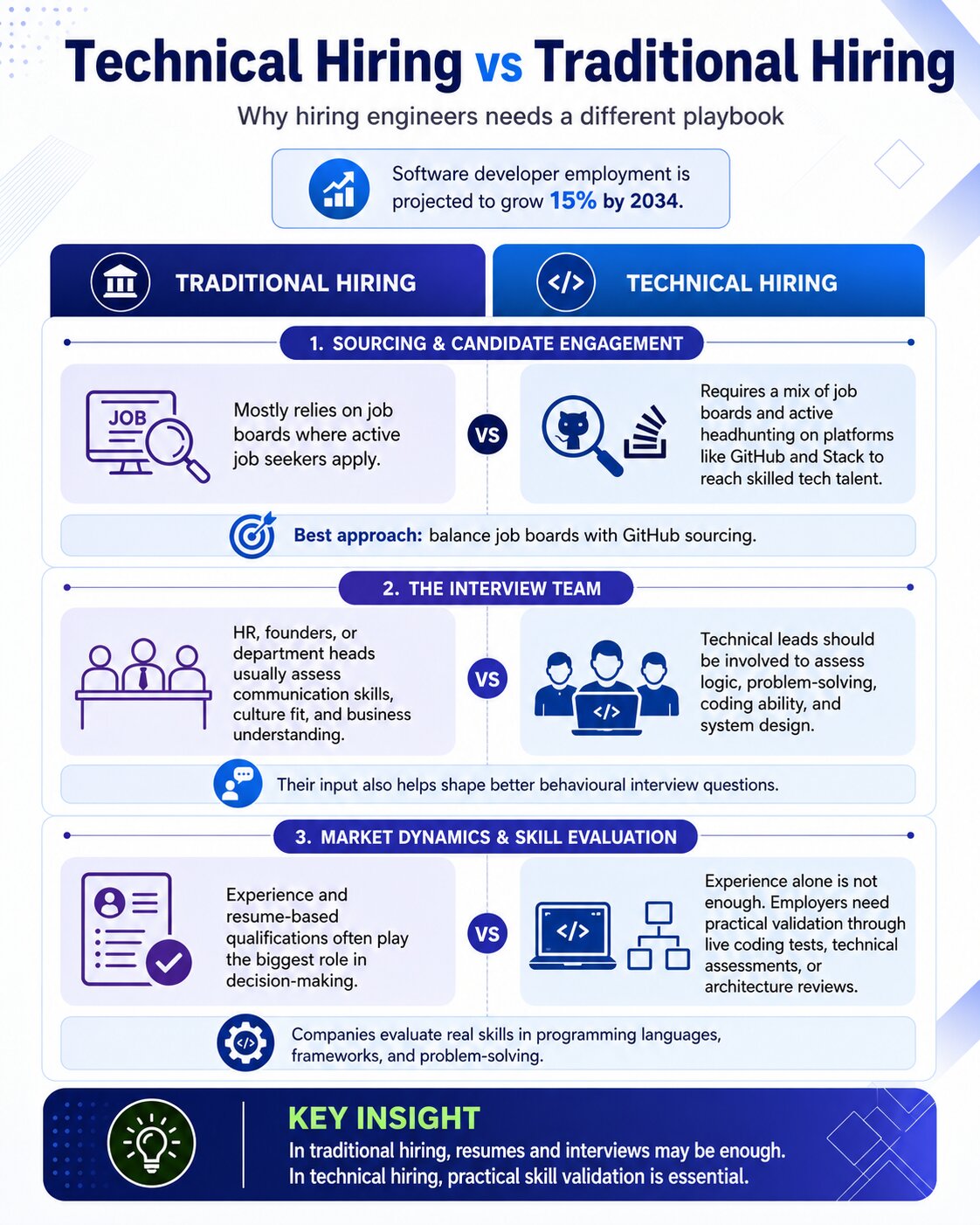
What makes technical hiring different from traditional hiring?
Why do many non-technical founders hire the wrong developers?
Non-technical founders hire the wrong developers because they lack technical literacy. Without technical knowledge, it becomes difficult to identify strong candidates.
The reasons why non-technical founders hire the wrong developers include:
- Following the general checklist: Many non-tech companies hiring developers expect one professional to handle everything. Conducting quality assurance (QA), deployment, frontend, and backend is not a one-person job. When founders give all these responsibilities to a single person, it leads to burnout.
- Judging solely by cost: Startups often try to save money by choosing the cheapest freelancer. Without the right coding tools, unfinished projects and query bugs can lead to security issues. You should therefore ensure you hire a candidate who is highly proficient in programming languages such as Python, R, and JavaScript to ensure smoother deliverables.
- Inability to vet technical skills: Without technical skills, non-technical founders struggle to hire technical professionals. You may not know how to code, which hinders your ability to evaluate a developer's true potential.
What Should You Define Before Hiring Any Tech Talent?
Hiring problems often occur before the interview process. Non-technical companies post unclear expectations, vague job descriptions, and unrealistic skill requirements. All these elements attract the wrong candidates, making the hiring process very difficult.
Before interviewing tech talent, such as developers, you should define your business needs. With a clear hiring structure, you can filter candidates faster and reduce hiring mistakes.
Here are the things you can define before hiring tech talent:
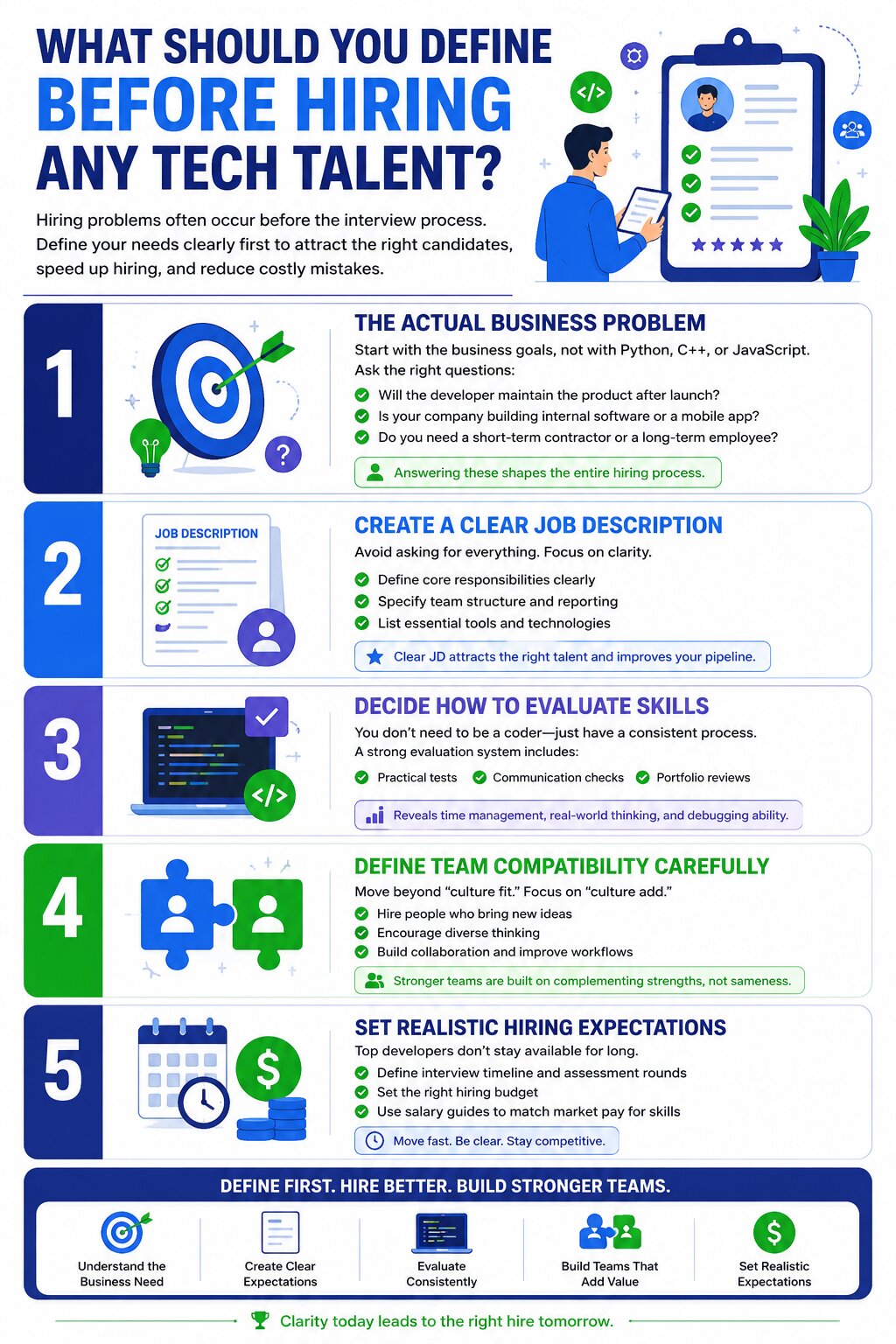
Since technical skills encompass security systems, cloud management, frontend development, and more, salaries may vary. In such a scenario, non-technical personnel can consult a salary guide based on the current pay range for technical skills. It will help set a clear budget that would match the candidate's profile.
How Can Non-Technical Founders Identify Real Technical Skills?
Technical candidates know how to write perfect resumes. However, resumes alone don’t highlight how they solve problems or build real-world applications. It also includes working with cutting-edge technologies such as Artificial Intelligence (AI) and Machine Learning (ML).
According to studies, business leaders in 2026 expect AI and ML growth of 45%. It shows that technical candidates now need to upgrade their skills to mark themselves as real talent.
Non-technical founders can therefore use a practical evaluation method to identify real technical skills.
Why are portfolios and GitHub profiles more valuable than resumes?
A resume tells what candidates claim they can do. GitHub profiles and portfolios demonstrate what they have actually built. In such a scenario, recruiters prioritize real project work during technical hiring. Proper GitHub profile analysis highlights project complexity, technical consistency, and collaboration ability. It also helps organizations understand how frequently technical candidates can contribute.
What should you look for in a developer portfolio?
When founders conduct a developer portfolio review, they look for project functionality, business relevance, and technical complexity. Non-technical founders don't have to understand every line of the code.
You should see how clearly the developer is explaining their thoughts and decisions. Pay attention to the products they have built. Ensure they highlight the challenges that they have faced during the work.
How can coding assessment platforms help reduce hiring mistakes?
Many organizations use testing platforms to hire technical candidates, including engineers. It can help you evaluate candidates' technical ability without reviewing the code. If you’re looking for employees for remote engineering teams, you can ask the individual to take a practical test on such platforms.
It will help evaluate data structures, backend logic, and fundamental systems design. Testing these elements will improve hiring quality and reduce mismatches.
How can you spot fake expertise or resume exaggeration?
Candidates may exaggerate their resumes to look more qualified. As a non-technical founder, you may miss warning signs by focusing on keywords and experience. To ensure you don't miss the red flags, check for unclear technical decisions, vague project explanations, and inconsistent timelines.
You can also ask the candidates about the issues they have solved or the bugs they've handled to understand their ability. These conversations provide a clearer picture of a technical person's work than interviews do.
How Should You Interview Developers If You Don’t Understand Code?
Many non-technical founders assume they can’t properly interview developers since they don’t understand coding. In reality, you do not need to test syntax or technical jargon yourself. You need to understand how candidates think, communicate, and approach problems.
A strong interview process helps you evaluate both technical ability and workplace compatibility without turning the conversation into a coding exam.
Non-technical founders feel nervous about interviewing developers because they feel they need coding skills to ask the right questions. In reality, you don't need to test technical jargon yourself. Understand how candidates communicate, think, and approach problems.
The following are the ways you can interview developers even without coding knowledge:
- Provide small assignments to candidates and ask a technical expert to review the quality, structure, and efficiency of their work.
- Use programming-language tests to evaluate coding logic and problem-solving skills.
- Ask candidates to explain the projects they've worked on. It will help reveal their ownership of the project and their troubleshooting ability.
- Give developers different scenarios and see how they adapt to them. It will help them learn new technologies when needed.
- Ask candidates to explain technical concepts in simple terms.
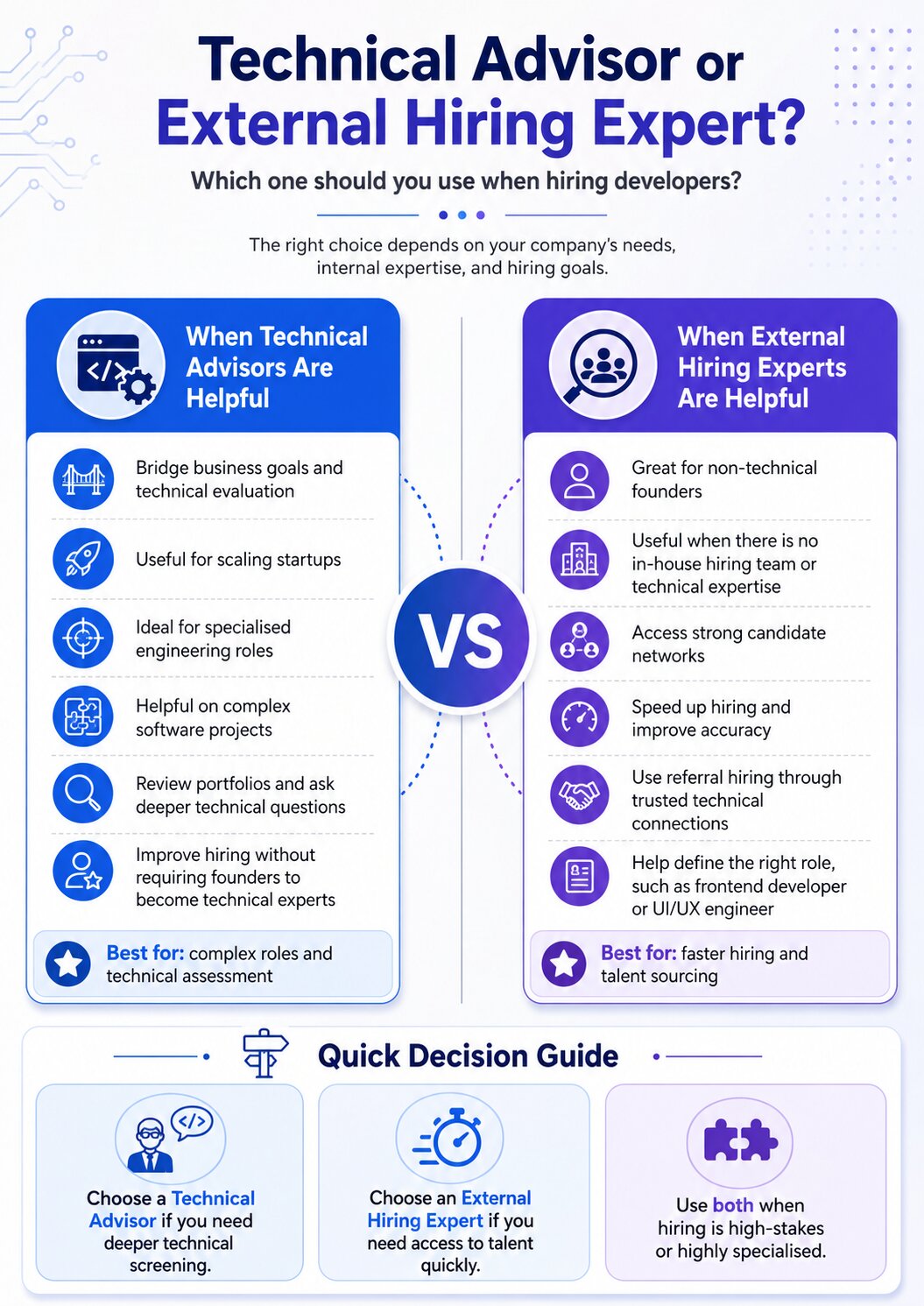
Should You Use a Technical Advisor or an External Hiring Expert?
For both technical and non-technical firms, hiring developers without relevant knowledge can be risky. While many companies rely on technical advisors for hiring, others prioritize external hiring experts.
However, it depends on your organization's requirements to choose between the two persons. Here are cases where technical advisors and external hiring experts can be helpful:
What Hiring Mistakes Should Non-Technical Founders Avoid?
Founders without technical knowledge rely on guesswork to hire technical persons. They use a resume as the primary tool to assess a candidate's ability, skipping the structured evaluation process. All these mistakes can significantly add to hiring costs.
Here are the hiring mistakes every non-technical founder should avoid:
- Relying heavily on resumes instead of skills: In resumes, candidates list down skills without demonstrating their application. You should ask for practical work samples to understand their technical capabilities.
- Skipping structured evaluation methods: Without a clear hiring process, each interview feels different. To ensure consistency, you should focus on live assessments. It will include building architectural models, codes, or system designs to show their skills.
- Prioritizing communication over technical ability: A candidate may have strong communication skills but poor coding skills. Create tests to assess coding performance.
- Hiring too quickly: Indeed, delays in the hiring process can lead to overlooking top technical professionals. However, rushing the hiring process can lead to the selection of the wrong candidates.
Find Top Tech Talent from Tech Disciples
So, how do you hire tech talent without a technical background? As a non-technical founder, it is an obvious question to ask yourself. Instead of relying on resumes, focus on evaluating real skills.
However, it doesn't mean you have to learn the fundamentals of coding. Ensure you don't rush the hiring process and include an external hiring expert or a technical advisor, depending on your business needs.
At Tech Disciples, we aim to connect businesses with technical professionals actively seeking opportunities. Whether your goal is to scale the team or build a product, we can provide you with the right talent pool.
Our priority is not limited to listing job vacancies. We also help potential candidates find jobs in the tech field. As we help screen better candidates, it also helps your companies to grow.
Take our help and get matched with the right tech talent that fits your business needs.
How Do I Hire Top Tech Talent If I’m Not a Technical Person: FAQ
1. How much does it typically cost to hire a software developer?
Hiring a software developer usually costs between $15 and $120+ (roughly $5,000 t 100,000+ per year). Hiring costs depend on the developer's location, talent pipeline, and skill level.
2. What is the difference between hiring junior, mid-level, and senior developers?
The difference between hiring junior, mid-level, and senior developers boils down to their problem-solving abilities, the scope of their impact, and their autonomy. Junior developers focus on basic tasks and require active supervision. Mid-level engineers work independently on routine features, and senior developers mentor the team, solve complex problems, and make architectural decisions.
3. How long does it usually take to hire top tech talent?
Hiring top tech talent typically takes 30 to 90 days. The process starts from the moment the job opens to the candidate's first day. However, the timeline can change regarding the interview process, efficiency, specialization, and seniority.
4. Should startups prioritize speed or quality when hiring developers?
Startups should prioritize speed over quality in the initial developer hires. But ensure they have strong engineering talent that fits your organization's culture. In the startup landscape, it is essential to launch quickly. It helps validate product fit based on user feedback, which is more crucial than creating accurate code from day one.
5. What red flags indicate a developer may not be trustworthy?
When a developer avoids documentation, makes unrealistic promises, and communicates vaguely, it may indicate they are not trustworthy. The professional should be transparent about their work and be willing to explain things clearly.
6. How important are soft skills in technical hiring decisions?
Soft skills are critical to the technical screening process. They often serve as the deciding factor between candidates with similar technical expertise. Having hard skills ensures candidates get shortlisted. But soft skills decide how well they can adapt to changing environments, apply their capabilities, and collaborate in teams.