
Building a strong engineering team is no longer just about filling open roles. Companies that take even one wrong hiring decision can slow their product delivery and create long-term operational problems.
Many startups and growing businesses make hiring decisions based only on developer salary comparison. They often ignore evaluating ownership, architecture planning, and scalability needs.
For some organizations, cheaper hiring may seem cost-effective initially. But the choice of the wrong experience level may cost them significantly due to delayed releases, weakened product quality, and reduced engineering velocity across the entire team.
These issues have led to the debate around hiring junior developers versus senior leads in 2026. With AI-assisted development tools for coding, businesses increasingly rely on experienced engineers for technical decision-making, reducing the need for hiring juniors.
If you are trying to find the right answer for the junior developer vs senior developer hiring debate, then we have the right answers.
In this blog, we will break down the differences between junior developers and senior leads, when to hire each role, and how businesses can make smarter startup hiring decisions in 2026.
What Is the Difference Between a Junior Developer and a Senior Lead?
To understand the difference better, you need to understand the function of each designation. A junior developer usually focuses on execution. In comparison, a senior does the major work. The professionals focus on ownership, architecture, scalability, mentoring, and strategic technical direction.
While both roles contribute to software delivery, their business impact is very different. The following table explains the differences clearly:
|
Parameter |
Junior Developer |
Senior Lead |
|
Typical Experience |
0–3 years |
7–12+ years |
|
Primary Responsibility |
Task execution |
Technical leadership |
|
Salary Range |
Lower upfront cost |
Higher investment |
|
Productivity Speed |
Slower independently |
Faster decision-making |
|
Supervision Required |
High |
Minimal |
|
Architecture Skills |
Limited |
Advanced |
When Should You Hire a Senior Lead Instead of a Junior Developer?
When deciding to hire a senior developer, companies need to consider multiple factors. Since it is a prestigious position, the company assesses the skills and capabilities of the candidate. However, before starting the hiring process, they need to analyze certain business goals.
The potential employee must be able to handle strategic technical direction, faster decision-making, and stronger engineering management. Even though the junior developers can support development tasks effectively, they need guidance on handling the major tasks.
It is the reason why companies dealing with complex products or aiming for scalability often choose experienced professionals. They want an individuals who can manage architecture planning, technical ownership, and long-term engineering scalability. Companies know that a senior does more than just write code.
These experts help companies reduce technical debt, improve code quality standards, guide agile development teams, and more. The following are the reason that makes hiring a senior lead valuable for a company:
- If the product involves complex or scalable software architecture.
- When the project requires strong technical ownership.
- For the times when your business needs faster software delivery and engineering velocity.
- If your existing team lacks experienced engineering leadership.
- To establish better code quality standards across projects.
- Effectively handle security-sensitive or high-risk operations.
- Your company is scaling rapidly and needs stronger engineering management.
- The team requires developer mentorship and technical guidance.
- To avoid long-term technical debt accumulation.
- When Does Hiring a Junior Developer Make More Sense?
It is a fact that a senior developer can help businesses grow or reach their target. However, not every business requires a highly experienced senior lead from the beginning.
In many situations, hiring a junior developer can be a practical decision for startups. It is valuable for companies that have stable workflows, supportive engineering teams, and long-term growth plans.
Businesses that understand how to train and guide early-career developers can gain benefits from hiring junior developers. Such choices can help them create a stronger team that offers scalability and lowers hiring costs.
The following are the reasons why hiring a junior developer usually makes more sense:
- When the company already has strong engineering leadership in place.
- If there are senior developers available to provide developer mentorship.
- The project requires lower technical complexity.
- For businesses wanting a more cost-effective hiring approach.
- Organizations that are building long-term developer growth potential.
- When the existing team maintains a clearly documented workflow and coding standards.
- When you are capable of dividing the tasks into smaller development responsibilities.
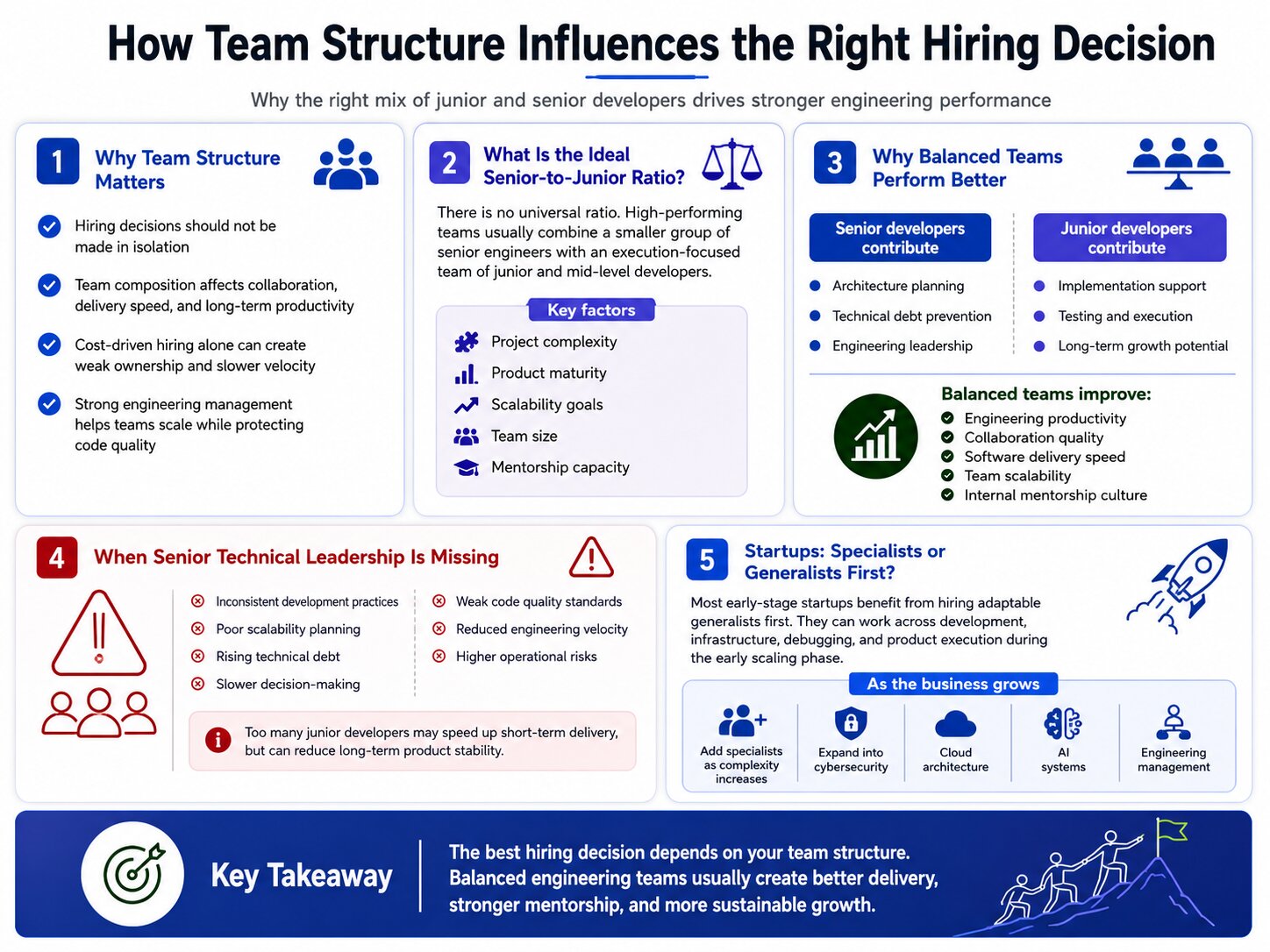
How Does Team Structure Influence the Right Hiring Decision?
While going through the reasons to hire junior developers, you might be wondering: Does the team structure influence the hiring choice?
The answer is yes. Taking decisions in isolation can lead to major errors. A company's overall team composition plays a major role in determining the choice from junior developers, senior leads, or a balanced combination of both.
A well-structured engineering team will help enhance collaboration, software delivery speed, and long-term engineering productivity. Businesses that simply focus on reducing hiring costs may have unbalanced teams with weak technical ownership and slower engineering velocity.
On the other hand, organizations with strategic engineering management and experienced staff can help the company scale efficiently and maintain code quality standards over time.
How Has AI Changed the Junior vs Senior Developer Debate in 2026?
The rise of AI-assisted development has significantly changed how companies evaluate developer experience levels in 2026. In the current market, companies are no longer hiring engineers based only on coding speed. Businesses now prioritize professionals who can manage AI-generated workflows and make strategic technical decisions.
They want candidates who are capable of maintaining good code quality standards across complex projects. Such a shift has strengthened the value of senior developers in modern engineering teams.
It is a fact that AI tools can automate repetitive coding tasks; however, they still lack precision. Only experienced professionals can handle the projects to create scalable software architecture, technical ownership, and engineering management responsibilities.
But what about the junior developers? AI has also impacted the role of junior developers. Many entry-level engineers now work alongside AI tools to improve productivity.
However, moving without proper guidance or mentorship may not be a suitable choice. Constantly relying on AI can increase technical debt and reduce long-term engineering quality.
The following are the common ways by which AI is influencing the junior developer vs senior developer debate:
- There is a greater emphasis on systems thinking over manual coding speed.
- Companies now have a demand for engineering leadership and technical ownership.
- Businesses prefer onboarding junior developers using AI tools.
- The focus has shifted to code quality standards and workflow validation.
- Businesses have effectively reduced dependence on repetitive development tasks.
- A higher value is placed on experienced developers who can supervise AI-assisted workflows.
- Product timelines are flexible enough to support onboarding and training.
- The business is focused on creating a stronger mentorship culture internally.
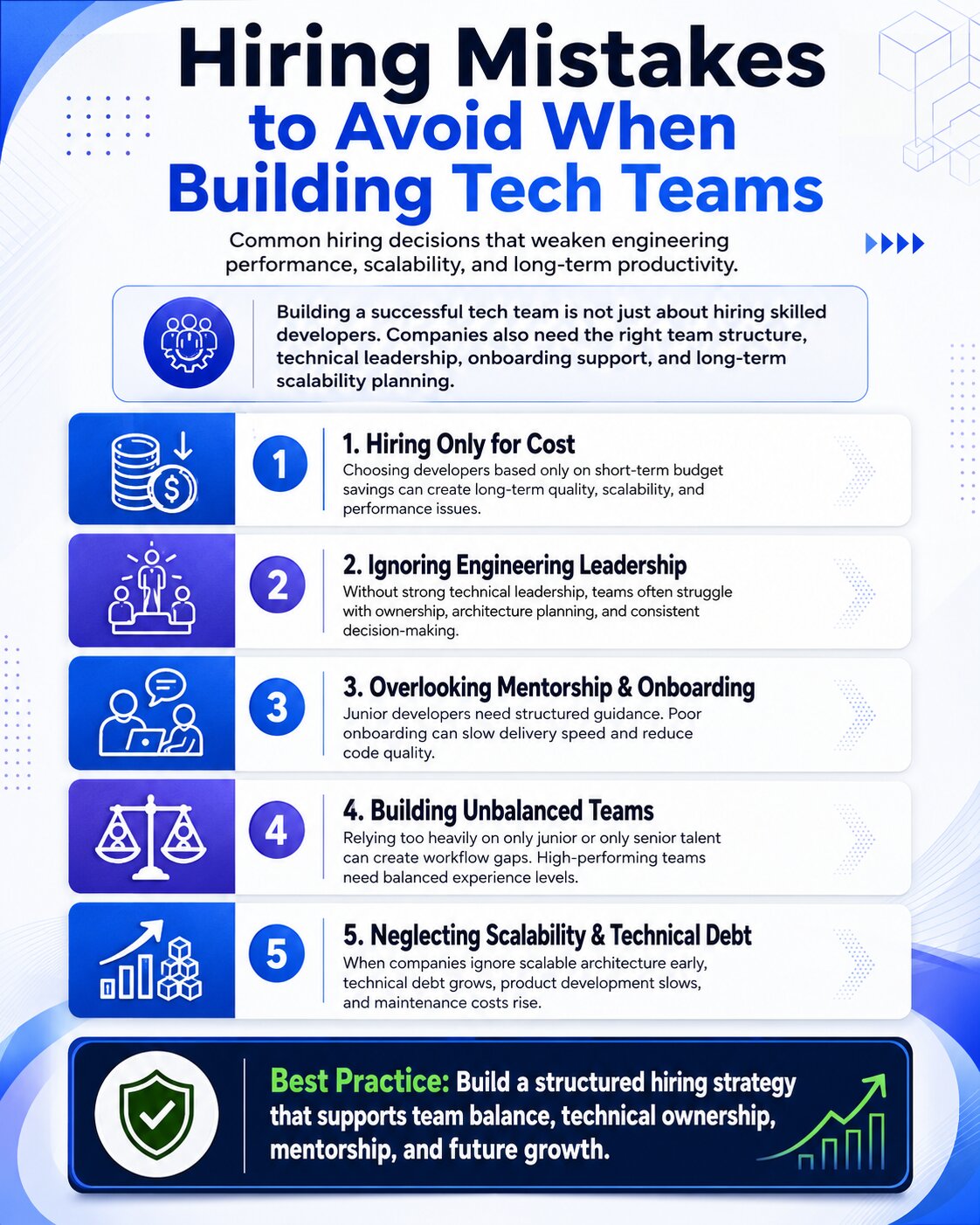
What Hiring Mistakes Should Companies Avoid When Building Tech Teams?
What Is the Best Hiring Strategy for Different Business Stages?
When it comes to the right hiring strategy, companies often prioritize their budget. Even though it is a crucial factor, the approach can become a blockage in gaining long-term scalability goals.
Relying only on a salary guide or prioritizing lower experience levels during hiring can create serious long-term engineering challenges for businesses.
In fact, a hiring approach that works for an early-stage startup may not be suitable for a growing enterprise. Businesses, therefore, need to assess developer experience levels before making the final choice. By selecting carefully, they can effectively maintain engineering productivity, increase software delivery speed, and achieve sustainable growth.
Here are some tips to help businesses of different sizes make the best hiring strategies:
- Early-Stage Startups: Startups that are in their early growth phase often benefit more from hiring experienced senior leads. These professionals can handle your technical ownership, architecture planning, and engineering management.
- Growing Mid-Size Companies: The companies that are slowly progressing must have a balanced mix of junior and senior developers. Senior engineers can provide you with developer mentorship and maintain code quality standards. The junior developers will handle the execution and long-term team scalability.
- Large Enterprises with Mature Engineering Teams: Established organizations usually require software engineers with specialized technical roles. These companies need to hire candidates who can provide engineering leadership, scalable software architecture, and cross-functional collaboration.
- High-Growth Companies: Businesses operating in highly competitive or rapidly evolving markets want engineering velocity. They want a team that can deliver software more quickly. In such environments, combining strong technical leadership with a scalable team can ensure long-term operational efficiency.
Build the Right Engineering Team for Long-Term Growth
Making a decision regarding choosing a junior developer vs. a senior developer is not simply restricted to a hiring decision. It is a long-term business strategy that directly affects engineering productivity, software delivery speed, and product stability.
Many companies get confused in the debate, simply focusing on project complexity, business goals, technical ownership, and overall team composition. Some companies may find junior developers the ideal choice due to strong growth potential and cost-effective hiring advantages.
While others may prefer senior leads due to their engineering leadership, scalable software architecture planning, and knowledge in handling growing teams, to ensure that the company gains long-term profit, maintaining the right balance between experience levels is often beneficial.
At Tech Disciples LLC, we help businesses make good hiring decisions by connecting with experienced engineering talent. By using our services, you can connect with good candidates who are trying to find jobs and become a part of high-performing development teams.
Whether you are scaling a startup or strengthening your operations, our team can help you make the right hiring strategy to accelerate long-term growth. Build a future-ready engineering team with confidence by exploring Tech Disciples today!
Should I Hire a Junior Developer or a Senior Lead for My Tech Team: FAQ
1. How many years of experience typically separate junior and senior developers?
Ans: Junior developers usually have 0–3 years of experience, while senior developers often possess 5–10 years of hands-on industry exposure. However, the values can differ from company to company. They may analyze your strong engineering leadership and technical ownership skills before making a choice.
2. Can a junior developer eventually replace the role of a senior engineer?
Ans: Yes, junior developers can gradually grow into senior engineering roles through continuous learning. Companies often ensure that the juniors get proper mentorship and real-world project experience over time.
3. How long does it usually take for junior developers to become fully productive?
Ans: The timeline for junior developers to become fully productive depends on the candidate and project complexity. Many junior developers can become significantly productive within 6–18 months under proper mentorship.
4. Are remote junior developers harder to manage than remote seniors?
Ans: No, remote junior developers are not harder to manage than remote seniors. They often require more communication, onboarding support, and mentorship compared to experienced senior engineers.
5. What personality traits make a great senior lead developer?
Ans: The personality traits that make a great senior lead developer are strong problem-solving abilities, communication skills, and leadership qualities. Strategic thinking and technical ownership are also important traits of successful senior lead developers.
6. How important are communication skills for technical leadership roles?
Ans: Communication skills are extremely important for senior engineering roles as they need to handle the team. Senior technical leaders have to coordinate with teams, explain decisions, and mentor juniors, for which communication is essential.
7. Should companies prioritize cultural fit or technical skills when hiring developers?
Ans: Businesses should always have a balance between both factors during hiring developers. They must choose candidates with strong technical skills, collaboration ability, and adaptability.
8. What industries benefit most from hiring senior developers first?
Ans: Industries involving AI, fintech, cybersecurity, healthcare technology, and SaaS platforms often benefit from hiring senior developers first. They can first work towards growth, then build a team of juniors.
9. Can freelance senior developers help startups before full-time hiring?
Ans: Yes, freelance senior developers can help startups establish scalable software architecture and engineering direction. It is essential for building permanent internal teams.
10. What metrics should companies track to evaluate developer performance?
Ans: Companies often evaluate developers based on software delivery speed, code quality standards, productivity, and collaboration efficiency. They should also check the candidates' communication and leadership skills to ensure smooth operation.