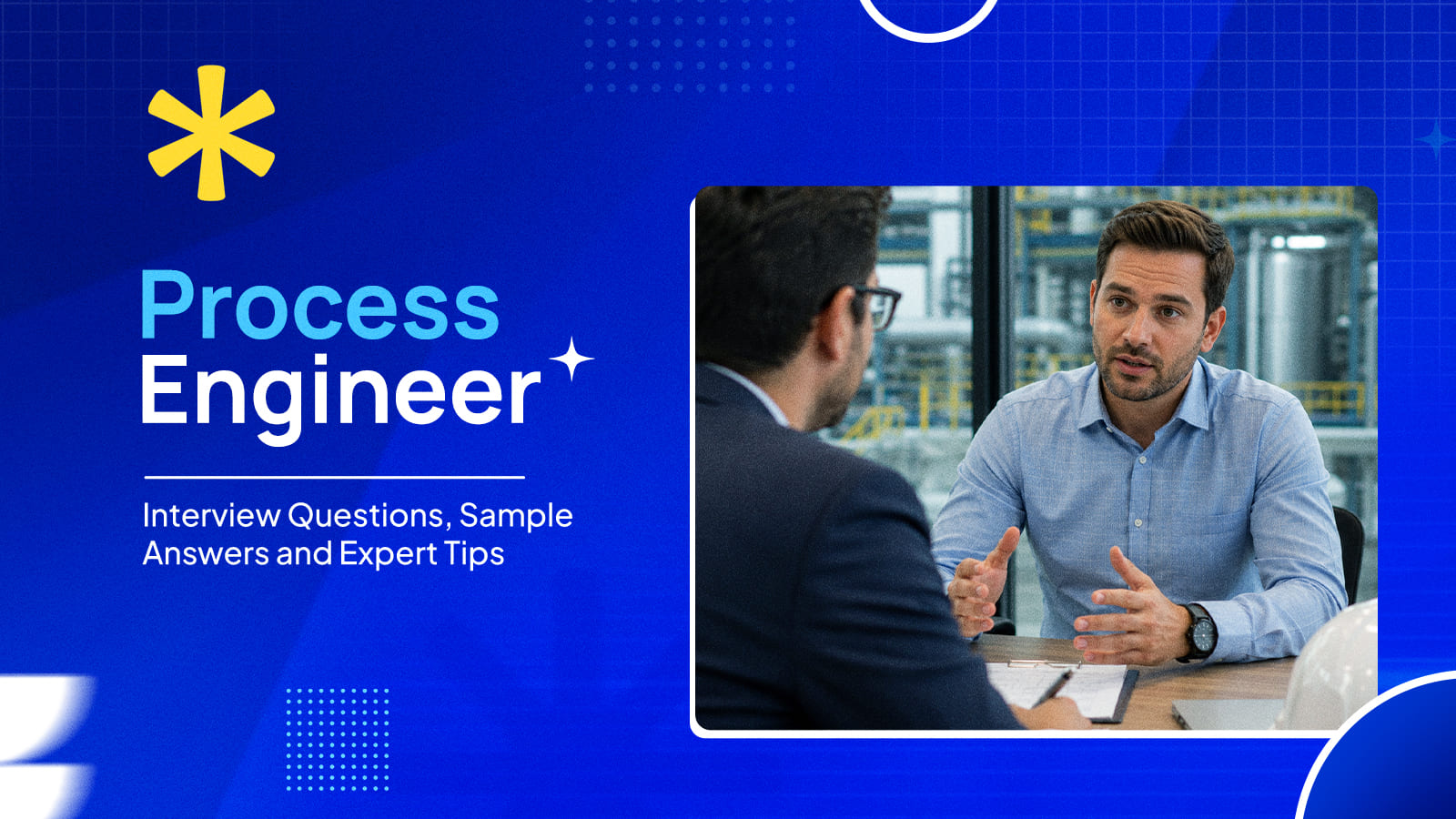
Are you looking for a process engineer job? You're confident in your ability to improve efficiency, solve production problems, reduce costs, and maintain quality.
But when it's time for the interview, you notice that technical knowledge alone isn't always enough. Employers want to understand how you approach engineering challenges.
They ask you questions to determine your capability to make decisions under pressure and apply your knowledge in the real world.
So, what's the trick to passing the stage securely? Preparing for process engineer interview questions helps you present your experience with confidence.
If you are preparing for the process engineer interview, you have come to the right place.
In this blog, we will discuss the most common interview questions, industry-specific scenarios, practical preparation strategies, and expert tips to help you succeed in your next process engineering interview.
What Does a Process Engineer Do?
A process engineer develops, improves, and monitors production processes. Their work is to ensure that the products are manufactured safely, efficiently, and consistently.
Their work focuses on increasing productivity, reducing waste, improving product quality, and solving operational problems before they affect production.
Understanding these responsibilities also helps you anticipate the type of process engineering interview questions employers are likely to ask.
Optimize Manufacturing Processes
Process engineers analyze existing workflows. It helps them identify inefficiencies and recommend improvements. They evaluate production data, eliminate bottlenecks, and introduce process changes.
Improve Product Quality
Process engineers work with quality assurance teams to identify defects. They investigate the root causes and implement corrective actions. Their goal is to reduce recurring issues.
Ensure Safety and Regulatory Compliance
Every process must meet workplace safety standards and industry regulations.
Process engineers assess potential risks and update operating procedures. It helps create safer production environments without compromising efficiency.
Collaborate with Cross-Functional Teams
Process engineers regularly work with production managers, maintenance teams, suppliers, and plant operators. They work to implement changes and resolve operational challenges.
Drive Continuous Improvement
Once improvements are implemented, process engineers track key performance indicators (KPIs). They check production efficiency, cycle time, defect rates, and equipment utilization. Using methodologies like Lean Manufacturing or Six Sigma, they continuously refine processes to achieve long-term operational improvements.
How to Prepare for a Process Engineer Interview?
Now that you understand what employers expect from a process engineer, the next step is preparing for the interview itself. A successful interview goes beyond answering technical questions correctly.
Strong process engineer interview preparation helps you explain your engineering decisions. It shows how you communicate your problem-solving approach and demonstrate how you've applied your knowledge in practical situations.
Review Core Engineering Fundamentals
Make sure to refresh concepts such as mass and energy balances, fluid mechanics, and more. Interviewers often use these topics to evaluate your engineering foundation.
Study the Company and Its Operations
The best strategy is to research the company's products, manufacturing processes, and recent developments. Having a clear idea about its operations allows you to tailor your answers effectively.
Revisit Your Projects and Achievements
Always discuss internships, academic projects, or previous work experience in detail. Make sure you explain the challenge, your role, and the solution you implemented.
Practice Technical and Behavioral Responses
Prepare for both engineering scenarios and workplace situations. Employers may ask how you've handled deadlines, teamwork, process failures, or unexpected production issues.
Strengthen Your Problem-Solving Approach
Practice explaining how you would identify a problem and analyze the root cause. A good way is to evaluate possible solutions. It will help you recommend the most effective course of action. This demonstrates structured engineering thinking rather than memorized answers.
Common Process Engineer Interview Questions
After reviewing engineering fundamentals and your past projects, the next step is practicing process engineer interview questions and answers.
Doing so helps you organize your thoughts before facing technical, behavioral, and problem-solving discussions.
Most interviews combine technical knowledge, problem-solving ability, and workplace scenarios to understand how you approach engineering challenges.
General Questions
These questions are asked by interviewers to understand your background, motivation, and communication skills.
- Tell me about yourself.
- Why do you want to become a process engineer?
- Why are you interested in our company?
- What strengths make you a good fit for this role?
- Where do you see yourself in five years?
Technical Questions
These process engineer technical interview questions assess your engineering knowledge and ability to apply technical concepts in real production environments.
- Explain the difference between a PFD and a P&ID.
- What is Lean Manufacturing, and how have you applied it?
- How do you perform root cause analysis?
- Explain the DMAIC methodology used in Six Sigma.
- What KPIs would you use to evaluate process performance?
- How do you validate that a process improvement has been successful?
Problem-Solving Questions
Interviewers use these questions to evaluate analytical thinking and engineering judgment.
- A production line suddenly experiences higher defect rates. How would you investigate the issue?
- How would you reduce process waste without affecting product quality?
- What would you do if a process improvement increased efficiency but introduced new safety concerns?
- How would you identify and remove a production bottleneck?
- Describe a situation where you solved a complex engineering problem.
Behavioral Questions
These process engineer behavioral interview questions help employers understand how you collaborate. They check how you communicate and handle workplace challenges.
- Tell me about a time you worked with a cross-functional team.
- Describe a conflict you experienced on a project.
- How do you prioritize multiple engineering tasks with tight deadlines?
- Tell me about a mistake you made and what you learned from it.
- Describe a time you had to adapt to an unexpected process change.
Industry-Specific Process Engineer Interview Questions
The interview process varies across industries because the responsibilities of a process engineer also change. While every employer assesses engineering fundamentals, the technical discussions are often tailored to the processes, equipment, and challenges specific to that industry.
Chemical Process Engineer
Chemical process engineer interview questions usually focus on process safety, reaction engineering, process calculations, and equipment used in chemical plants.
You may be asked:
- How would you improve the efficiency of a distillation column?
- What factors affect reactor performance?
- How do you perform a HAZOP study?
- Explain the importance of mass and energy balances.
- How would you investigate an unexpected pressure increase in a process unit?
Manufacturing Process Engineer
Manufacturing process engineer interview questions typically assess your ability to improve production efficiency. The questions may check how you reduce waste, maintain product quality, and support continuous improvement initiatives.
You may be asked:
- How would you identify a production bottleneck?
- Describe a Lean Manufacturing project you've worked on.
- Which production KPIs do you monitor regularly?
- How would you reduce scrap without affecting output?
- Tell us about a successful process improvement you've implemented.
Senior Process Engineer
Senior process engineer interview questions place greater emphasis on leadership, project management, and making engineering decisions that improve long-term operational performance.
You may be asked:
- Tell us about the most challenging improvement project you've led.
- How do you prioritize multiple process improvement initiatives?
- Describe a time you managed resistance to a major process change.
- How do you mentor junior engineers?
- How do you balance productivity with safety and regulatory compliance?
Common Mistakes Candidates Make
Even well-qualified candidates can lose opportunities because of avoidable interview mistakes. Employers don't expect you to know every answer.
However, they do expect you to demonstrate preparation, logical thinking, and professionalism throughout the process engineering job interview.
- Memorizing answers instead of understanding concepts. Interviewers often ask follow-up questions to see how you apply engineering principles in real situations.
- Ignoring process safety in your responses. Safety should be part of your thought process when discussing process improvements, troubleshooting, or production efficiency.
- Giving vague project explanations. Instead of saying you "improved a process," explain the problem, your role, the solution you implemented, and the measurable outcome.
- Overlooking company research. Failing to understand the company's products, manufacturing processes, or industry can make your answers sound generic.
- Focusing only on technical knowledge. Strong communication, teamwork, and decision-making are just as important as engineering expertise.
- Not asking thoughtful questions. Interviews are a two-way discussion. Asking relevant questions about the role, projects, or team demonstrates genuine interest and preparation.
Expert Tips to Ace Your Process Engineer Interview
It is a fact that technical knowledge helps you qualify for the interview. However, it is rarely the only factor that determines the outcome.
Hiring managers also pay close attention to how you explain your decisions. They check your approach to unfamiliar problems and how you communicate with different stakeholders.
Small changes in the way you answer questions can make a significant difference. They may even check your CV and cover letter to ask about technical qualifications. In this regard, knowing the difference between CV vs cover letter and the things to add to them can prove fruitful.
Explain Your Thought Process
Interviewers want to understand how you arrive at a solution. When discussing a production issue or process improvement, walk them through the steps you would take before presenting your recommendation.
Instead of saying, "I would replace the equipment," explain that you would first review production data, identify the root cause, evaluate process variables, and compare alternative solutions before recommending equipment replacement.
Quantify Your Engineering Achievements
Whenever you describe a project, include measurable results. Numbers make your contribution more credible and easier for interviewers to evaluate.
For example, instead of saying you improved a process, explain that the improvement reduced cycle time by 12%, lowered scrap by 8%, or increased production capacity by 15%.
Connect Technical Decisions to Business Impact
Strong process engineers understand that engineering decisions affect production, quality, safety, and operating costs. Show interviewers that you consider the bigger picture.
Be Honest About Knowledge Gaps
No candidate knows every answer. If you're unfamiliar with a question, explain how you would approach the problem instead of guessing. A structured thought process often leaves a better impression than an incorrect answer.
End with Thoughtful Questions
Prepare a few questions about current process improvement projects, manufacturing challenges, or professional development opportunities. This demonstrates genuine interest in both the role and the organization.
Final Interview Checklist
By this point, you've reviewed the role, practiced common interview questions, and learned how to present your engineering experience effectively. Before you walk into the interview, take a few minutes to do one final review.
The following process engineer interview tips can help you communicate your technical expertise more effectively.
- Review the job description and key responsibilities.
- Check some cover letter examples and prepare a stronger one for yourself.
- Revise core process engineering concepts relevant to the role.
- Refresh Lean Manufacturing, Six Sigma, and Root Cause Analysis fundamentals.
- Revisit your engineering projects and measurable achievements.
- Practice explaining technical decisions with clear examples.
- Prepare for troubleshooting and process optimization scenarios.
- Research the company's products, processes, and recent developments.
- Keep your resume and supporting documents ready.
- Prepare thoughtful questions for the interviewer.
- Confirm the interview time, location, or meeting link.
- Dress professionally and arrive early.
Master Your Process Engineer Interview with Tech Disciples LLC
Preparing for process engineer interview questions is about more than learning the right answers. It requires a solid understanding of engineering fundamentals and practical problem-solving skills. You need to have the confidence to explain your decisions with clarity during every stage of the interview.
At Tech Disciples LLC, we connect skilled engineering and technology professionals with organizations looking for talent that can solve real business challenges. Beyond recruitment, we provide practical career resources that help candidates prepare for today's competitive hiring process.
By asking the best technical screening questions and connecting with candidates from our portal, you can strengthen your technical team.
Candidates can also find additional insights from us to learn how employers evaluate technical talent and what to expect during the screening stage.
Take the next step in your career with confidence by exploring Tech Disciples LLC's resources and preparing for every stage of your engineering interview journey.
FAQs
1. How long does a process engineer interview usually take?
A typical process engineer interview lasts between 30 and 60 minutes for the initial round. The final-stage interview may take 60 to 90 minutes. It would be longer when they include engineering discussions, case studies, or problem-solving exercises.
2. What technical skills are most important for a process engineer interview?
During the interviews, the employer commonly assesses your technical knowledge. They would ask about process optimization, thermodynamics, heat transfer, fluid mechanics, process control, Lean Manufacturing, and more. They may also ask about process safety, equipment design, and production efficiency.
3. What should I wear to a process engineer interview?
You should always wear professional business attire to an interview. A well-fitted shirt, formal trousers, polished shoes, and minimal accessories make the perfect professional outfit. For virtual interviews, maintain the same level of professionalism.
4. How can I answer process engineer interview questions if I have no experience?
If you have no experience in process engineering, try to remain calm and confident. You need to highlight your academic projects, internships, laboratory work, research, or engineering competitions. Explain the problem you worked on, your approach, and the engineering principles you applied.
5. What questions should I ask the interviewer for a process engineer role?
You should always ask one or two questions at the end of the interview. You can ask about the company's manufacturing processes, current process improvement initiatives, engineering tools, and how success is measured in the role. Such questions would demonstrate your genuine interest and preparation.
6. How many interview rounds are common for process engineer positions?
For process engineer positions, most employers conduct two to four interview rounds. It typically includes an HR screening, a technical interview, and a hiring manager discussion. In some cases, there can be a final leadership interview or plant assessment.
7. Do process engineer interviews include technical assessments or aptitude tests?
Yes, many employers include technical assessments and aptitude tests. They may want to check your practical problem-solving exercises to evaluate analytical thinking. However, the format depends on the industry, company, and seniority of the position.