Recruiters and Talent Acquisition Managers are two essential professionals who help businesses evaluate and hire talented candidates. However, this has brought in confusion about whether their roles are similar.
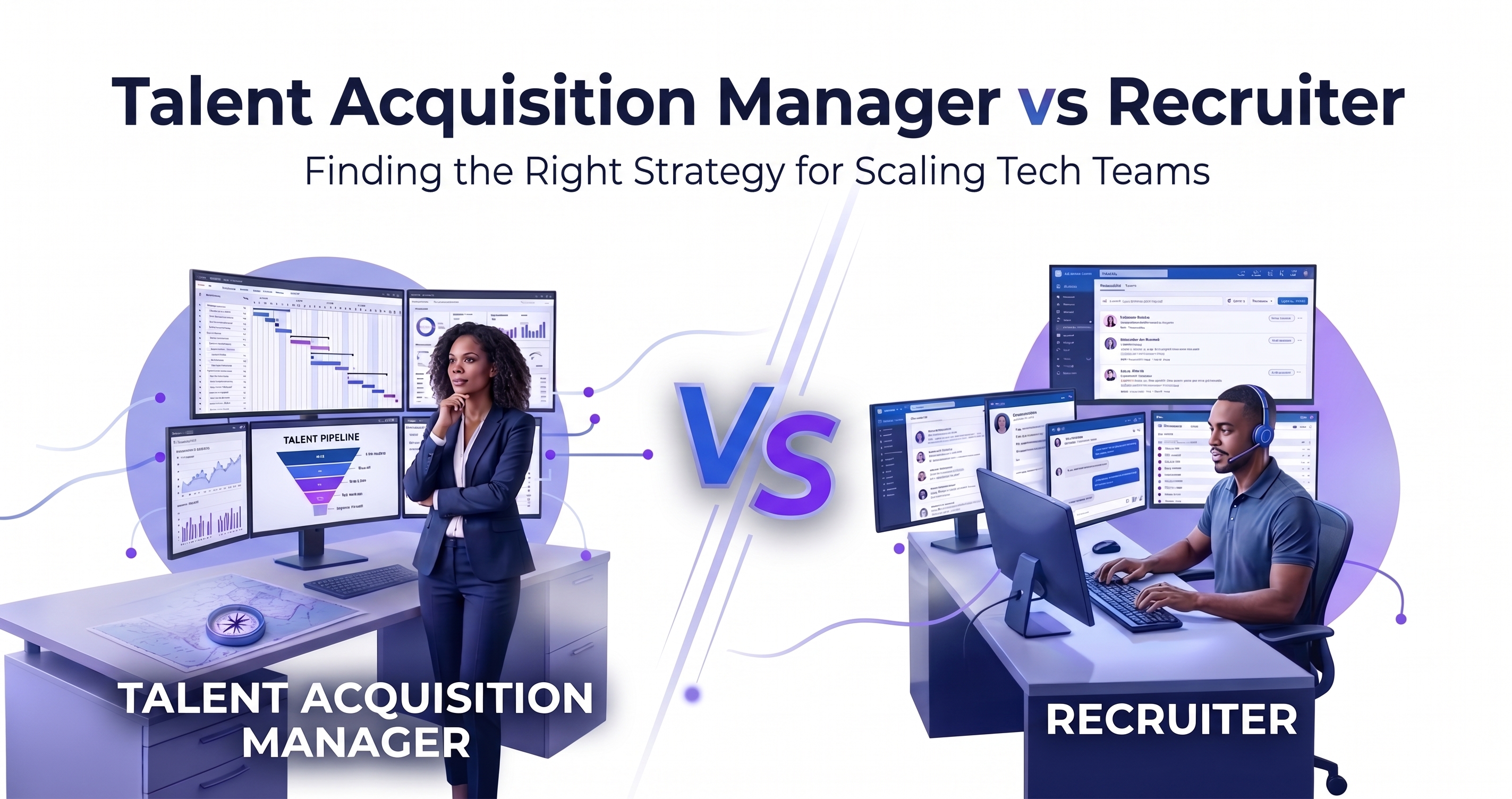
In reality, their responsibilities differ significantly. Recruiters focus on filling active vacancies, while a Talent Acquisition Manager builds the hiring infrastructure to scale technical teams.
Learning the distinction is becoming increasingly important as technology hiring grows more competitive. Companies planning to expand their engineering teams with a long-term hiring strategy need to make the right choices.
The right recruitment team will help your organization reduce recruitment bottlenecks and support sustainable team growth.
If you are trying to learn which role delivers the greatest value, you have come to the right place.
In this blog, we'll explore the differences between recruiters and Talent Acquisition Managers, when companies should hire each role, and how both contribute to building high-performing tech teams.
What Is the Difference Between a Talent Acquisition Manager and a Recruiter for Scaling Tech Teams?
Do you know tech hiring does not fail because companies lack candidates? It fails when roles, expectations, and hiring ownership are unclear.
One of the biggest issues is that recruiters and Talent Acquisition Managers are often grouped into the same category. It leads to confusion and delay in hiring decisions.
These professionals operate at fundamentally different levels of the hiring system. A recruiter simply focuses on executing active hiring needs and filling open roles.
A Talent Acquisition Manager focuses on designing and sustaining the hiring infrastructure. Their choice allows those roles to be filled consistently at scale.
The following table explains the difference clearly:
| Factors | Recruiter | Talent Acquisition Manager |
| Primary purpose | Fill open job roles efficiently | Build and manage a long-term hiring strategy. |
| Hiring approach | Reactive (works on active requisitions) | Proactive (plans future hiring needs) |
| Focus area | Candidate sourcing and screening. | Workforce planning and pipeline development. |
| Time horizon | Short-term hiring goals | Long-term organizational growth. |
| Core responsibility | Closing vacancies | Designing hiring systems and frameworks. |
| Candidate engagement | Active candidates and applicants. | Passive candidates and talent pools. |
| Tools and systems | ATS, job boards, sourcing platforms. | ATS + CRM, talent pipelines, recruitment marketing tools. |
What Does a Recruiter Own When Technical Roles Are Already Open?
A recruiter steps in when a hiring need is already defined and approved. The focus is on immediate execution and finding qualified candidates. They start moving them through the interview pipeline and ensuring roles are filled within the required timeline. In technical hiring environments, this role is highly operational and demand-driven. Success depends entirely on speed, coordination, and a consistent flow of candidates.
Recruiters ideally work with hiring managers and act as the source for locating talented candidates and fulfilling demand and market supply. Their ownership is centered on converting open requisitions into completed hires through structured sourcing and screening.
• Managing active job requisitions assigned by hiring managers.
• Finding candidates through multiple sourcing channels such as job boards, LinkedIn, referrals, and niche technical platforms.
• Screening resumes for role fit, technical alignment, and basic eligibility.
• Coordinating interviews and supporting technical screens between candidates, engineers, and stakeholders.
• Maintaining candidate progress and updates in the ATS.
• Ensuring smooth communication throughout the hiring cycle.
• Reducing time-to-fill by keeping the pipeline active and moving.
What Does a Talent Acquisition Manager Build Before Engineering Roles Open?
The right hiring structure depends on how mature the company’s engineering growth is and how predictable its hiring demand has become. Early-stage companies usually operate with urgent and unpredictable hiring needs.
While the scaling organizations require structured systems to sustain continuous technical hiring. This makes the decision focus on hiring complexity, volume, and long-term workforce planning maturity.
In practice, companies evolve through distinct hiring stages. These stages also help identify skill gaps within engineering teams that must be addressed through structured hiring plans.
Each stage benefits from a different mix of recruiting capability and talent acquisition strategy. Headcount planning also helps stay aligned with business growth and engineering capacity forecasting.
• Early-stage startups should prioritize recruiters or external agencies for immediate role fulfillment.
• Growth-stage companies benefit from combining recruiters with a Talent Acquisition Manager to build structured pipelines.
• Build candidate relationship management systems for long-term talent engagement.
• Scaling or enterprise teams require both roles working in parallel for execution and a long-term hiring strategy.
• High-growth engineering teams need Talent Acquisition Managers to support workforce planning and recruiters to handle active requisitions.
• Companies with unpredictable hiring demand benefit from flexible recruiting support paired with strategic TA oversight.
When Should a Tech Company Hire a Recruiter, a Talent Acquisition Manager, or Both?
Hiring decisions in tech companies are rarely about job titles alone. They are driven by how quickly the organization needs to scale and how predictable its hiring demand is. It also depends on whether the company is still reacting to vacancies or actively planning future workforce needs. A mismatch between the hiring stage often leads to slow recruitment cycles, weak pipelines, and inconsistent candidate quality.
The most effective hiring structure depends on the company’s growth stage and the maturity of its talent acquisition system. As organizations move from early-stage development to scaling engineering teams, the need shifts from execution-heavy recruiting to a combination of execution and strategic sucession planning.
Early-Stage Startups Hiring for Immediate Engineering Needs
The early-stage startups basically work towards fulfilling the urgent hiring needs. Their priority is to fill critical engineering roles quickly to support product development and release cycles. In this stage, hiring is execution-focused rather than system-driven.
• Focus is on closing active job openings quickly.
• Recruiters or external agencies are usually sufficient.
• Minimal emphasis on long-term workforce planning.
• Hiring decisions are often made directly by founders or engineering leads.
• Speed is prioritized over building structured pipelines.
Growth-Stage Companies Building Structured Hiring Capability
As companies grow, hiring volume increases and role complexity expands. At this stage, relying only on reactive recruiting leads to pipeline gaps and slower hiring cycles. Organizations begin to introduce structured talent acquisition functions alongside recruiters.
• The company needs to have a combination of recruiters and Talent Acquisition Managers working collaboratively.
• Workforce planning becomes more structured and predictable.
• Employer branding and sourcing strategy start becoming important.
• Recruitment marketing initiatives become essential to attract high-quality technical candidates.
Scaling or Enterprise Tech Teams Focused on Long-Term Hiring Systems
At scale, hiring becomes a continuous system rather than a reactive function. Engineering growth depends on stable pipelines, structured workforce planning, and consistent talent availability across multiple roles and skill sets.
• TA Managers drive workforce planning and strategic hiring architecture.
• Recruiters ensure the continuous execution of open roles.
• Recruitment systems rely heavily on ATS and CRM integration.
• Focus shifts toward quality-of-hire and long-term hiring efficiency.
How Do Recruiters and Talent Acquisition Managers Change the Tech Hiring Process?
By now, you have a basic idea of how the tech hiring process works. It is driven by recruiters alone or supported by a Talent Acquisition Manager-led system. However, you need to know that in the recruiter-led model, hiring is triggered only when a role becomes active.
While a Talent Acquisition Manager introduces structure before hiring demand appears. The individuals' work is to ensure that the pipelines, sourcing channels, and workforce plans are in action.
This difference directly impacts how fast roles are filled, how consistently candidates are sourced, and how predictable hiring outcomes become. It also influences key hiring metrics such as time-to-hire, time-to-fill, and cost-per-hire efficiency across recruitment cycles. In fast-scaling engineering teams, the shift from reactive hiring to proactive talent acquisition is often what separates stable growth from constant hiring bottlenecks.
Recruiter-Driven Hiring Process Focused on Immediate Role Closure
There are times when the company requires the guidance of a senior team member. It increases the need for immediate hiring. The recruiter-driven model begins only after a job requisition is opened. The recruiter focuses on sourcing, screening, and closing candidates quickly based on predefined role requirements. Success is primarily measured by speed and efficiency in filling active vacancies.
Talent Acquisition Manager-Driven Hiring Process Built on Proactive Planning
Another important hiring approach is the proactive strategy. It begins before roles are officially opened. In this process, the focus is on building pipelines, engaging passive candidates, and aligning hiring with workforce planning. The goal is to ensure hiring readiness rather than just filling immediate roles.
Integrated Hiring Model Combining Recruiters and Talent Acquisition Managers
This model combines execution and strategy into one system. Recruiters manage active hiring needs while Talent Acquisition Managers build long-term pipelines and hiring frameworks. Together, they create a more stable and scalable hiring process for growing tech teams.
What Mistakes Do Companies Make When They Confuse Recruiters with Talent Acquisition Managers?
While going through the different hiring structures, you might have wondered: the process must be quite smooth.
In reality, it can be easy when the hiring team works with a plan of action. Many believe that hiring challenges in tech teams are due to a lack of talent in the market. However, it comes from unclear expectations about who owns which part of the hiring process.
When companies treat recruiters and Talent Acquisition Managers similarly, they often end up assigning the wrong responsibilities. The misalignment slows down hiring, reduces pipeline quality, and creates unnecessary pressure on internal teams.
For growing businesses, such confusion can create issues and even become costly. It is because hiring demand increases faster than hiring systems mature. So, what's the end result?
It leads to fragmented ownership, inconsistent candidate experience, and inefficient use of recruitment resources.
• Expecting recruiters to handle workforce planning and long-term hiring strategy.
• Assigning Talent Acquisition Managers only to reactive job filling instead of strategic planning.
• Over-reliance on job postings without building structured candidate pipelines.
• Measuring all hiring success solely through time-to-fill metrics.
• Ignoring the importance of recruitment CRM systems for passive candidate engagement.
• Lacking a clear separation between sourcing, screening, and strategic planning responsibilities.
• Overloading recruiters with both high-volume sourcing and complex stakeholder strategy.
• Delaying employer branding efforts until hiring shortages become critical.
Which Role Should You Choose for Scaling Your Tech Team?
Now comes the essential question: who should you select between a Recruiter and a Talent Acquisition Manager? The answer depends on how your organization is scaling and how predictable your hiring demand is. You also need to check whether they company needs immediate role fulfillment or long-term hiring capability. Most tech companies do not need one over the other permanently. They need the right function at the right stage of growth.
The decision should always be based on whether your hiring process is already structured for scale. Once engineering teams begin expanding consistently, relying on only one function often creates bottlenecks in either execution speed or pipeline readiness.
Hiring decisions often become complex for non-technical founders and managers who wonder how to hire top tech talent if I’m not a technical person. This is common in cases when they cannot directly evaluate engineering skills or technical depth.
The following points can make your hiring process a little smoother:
• Choose a Recruiter if your primary need is to fill active engineering roles quickly.
• Choose a Talent Acquisition Manager if you need structured workforce planning and pipeline development.
• Choose both if your organization is scaling and requires continuous hiring at volume.
• Prioritize recruiters in early stages where speed of hiring is critical.
• Prioritize Talent Acquisition Managers in growth stages where hiring strategy becomes essential.
Build a Stronger Tech Hiring Strategy with Tech Disciples LLC
For a scaling company, the Talent Acquisition Manager and the recruiter are two essential roles. However, many still confuse about the distinction of these profiles.
A Talent Acquisition Manager works towards driving a long-term hiring structure through workforce planning and strategic techniques. However, a recruiter focuses on finding good candidates for active roles and ensuring the fast closure of open positions. Both these resources work collaboratively to help create a balanced hiring system. Their target is to support immediate delivery needs and sustainable engineering team growth.
This is why a scalable company must understand the value of these roles. It will help them use each role properly, reduce hiring delays, improve candidate quality, and scale engineering teams more effectively.
At Tech Disciples LLC, we make the process simpler by connecting companies with talented candidates actively looking for opportunities in strong and growing organizations.
Our team also acts as a guide for hiring teams by helping them understand the best technical screening questions to ask, enabling more accurate evaluation of technical skills and role fit.
Make your tech hiring more structured, efficient, and outcome-driven by connecting with Tech Disciples LLC today!
FAQ:
1. Can a technical recruiter grow into a Talent Acquisition Manager role?
Yes, many Talent Acquisition Managers start their careers as recruiters. The shift usually happens when they gain experience in strategic hiring, workforce planning, and stakeholder management. Over time, they move from execution-focused work to designing hiring systems. It’s a common and natural career progression in tech hiring.
2. Is a fractional Talent Acquisition Manager a good option for startups?
Yes, it’s a strong option for startups that need a hiring strategy but cannot afford a full-time role. A fractional TA manager helps build structure, define processes, and guide early hiring decisions. This allows startups to avoid chaotic hiring practices. It’s especially useful during early growth phases.
3. Should a startup use an agency recruiter before hiring in-house?
Yes, a startup should use an agency recruiter for good hiring. They are quite helpful when a startup needs an immediate candidate. These recruiters bring ready talent networks and can fill urgent roles faster than building internal systems.
4. What is the difference between a sourcer and a recruiter in technical hiring?
There is a major difference between a sourcer and a recruiter in technical hiring. A sourcer focuses only on finding and engaging potential candidates from different platforms. However, a recruiter manages the full hiring cycle, from interviews to offer closure.
5. How many technical roles can one recruiter handle at a time?
It depends on the complexity of the roles and the seniority level required. On average, technical recruiters handle fewer roles compared to non-technical hiring due to deeper screening needs. High-complexity roles require more time per candidate. So, capacity varies widely across organizations.
6. How can companies avoid bias when scaling technical hiring?
Companies can reduce bias by using structured interview frameworks. They should always offer clear role definitions and ask consistent questions across candidates. Such choices would ensure that fairness is maintained during hiring.
7. Does remote or offshore tech hiring change the recruiter vs TA manager decision?
No, remote and offshore hiring doesn't complicate the recruiter vs TA manager decision. The decision is always based on the company's pipeline and structured processes across time zones.
8. What should recruiter incentives be based on for technical hiring?
Recruiter incentives should focus on the quality of hire. Metrics like hiring manager satisfaction and candidate retention are the two vital parts of the hiring process. It ensures that the recruiters don’t prioritize quantity or bias over the ideal fit.
9. How involved should CTOs and engineering managers be in talent acquisition?
CTOs and engineering managers should definitely be involved in the hiring process. They can define the technical requirements and evaluate final candidates. However, they should not be involved in sourcing or pipeline management.
10. What is the difference between RPO and hiring an internal Talent Acquisition Manager?
A RPO or Recruitment Process Outsourcing is an external service where a vendor handles the hiring. While an internal Talent Acquisition Manager builds long-term hiring systems inside the company.