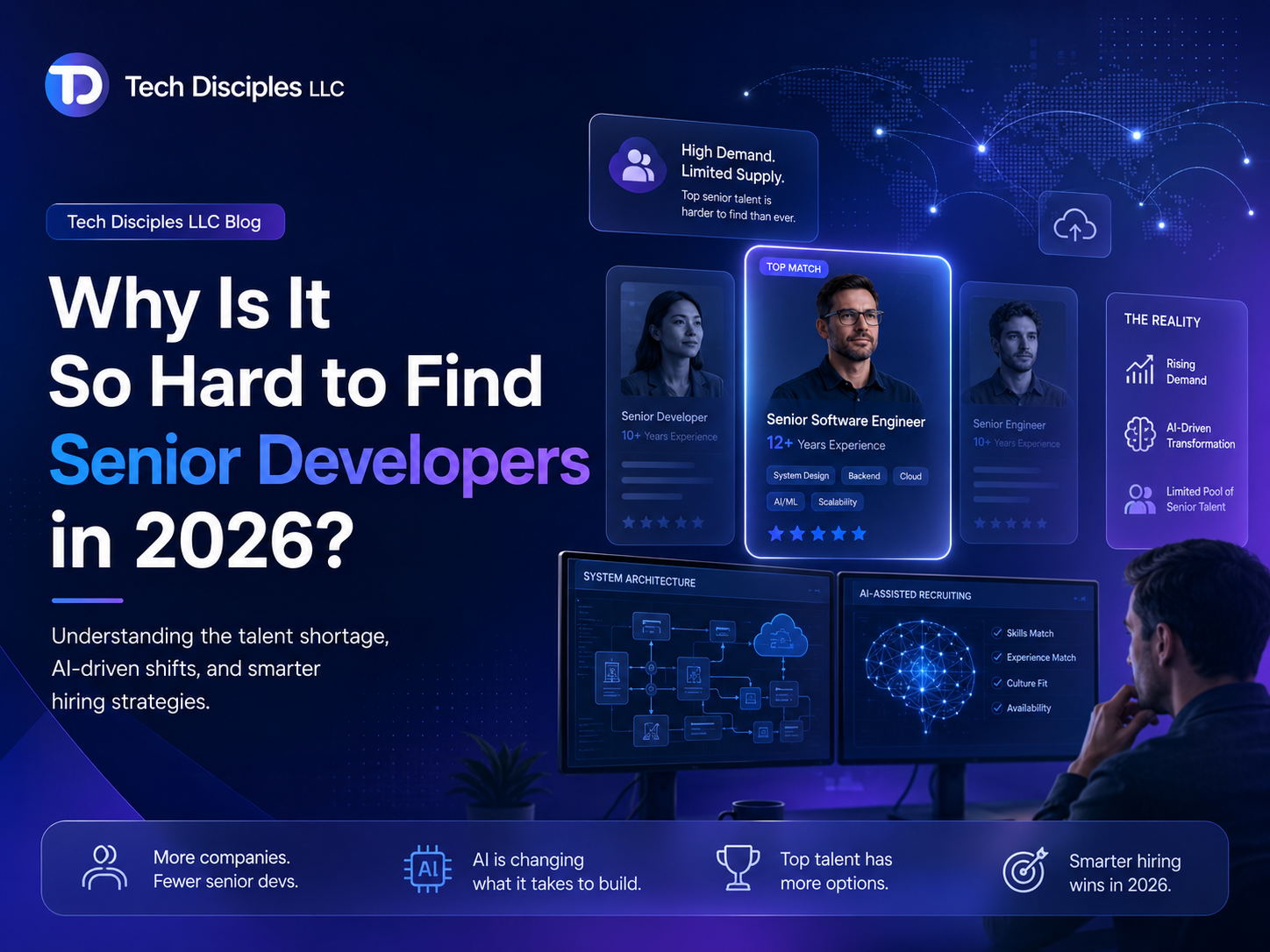
It is no secret that the current market is increasingly driven by technology development and automation. From app development and cloud infrastructure to large-scale data operations, nearly every industry now depends on software-powered systems.
This rapid digital expansion has significantly increased the demand for experienced developers. A study further projects that the employment for software developers will grow by 15% by 2034. However, this rising demand has also created one of the biggest hiring challenges for businesses today: finding the right senior engineers and developers.
Companies are now spending months competing against rising developer compensation trends, passive candidates, and shrinking talent availability. The preference for AI-assisted development has also increased the demand for professionals with strong systems thinking, strategic decision-making, and engineering leadership skills.
If your company is still relying on outdated hiring practices to recruit software developers, it may be lacking in the modern talent market.
In this blog, we will explore why senior developer hiring has become so difficult in 2026, the hidden factors driving the talent shortage, and the practical hiring strategies businesses can use to attract top engineering talent.
Why Is Finding Senior Developers So Difficult in 2026?
The demand for experienced software developers has skyrocketed in 2026. However, the hiring process has become a struggle due to the lack of skilled talent.
Organizations across industries face serious hiring bottlenecks due to the lower availability of candidates who can handle complex architectures, AI-assisted workflows, and large-scale engineering operations.
As compared to the earlier years, the companies are no longer preferring developers skilled in coding expertise. They require professionals who can combine technical execution with systems thinking.
Only a professional capable of planning, problem-solving, and cross-functional collaboration can grow in the changing market. Such a shift has made senior-level hiring far more competitive than before.
Several long-term industry changes have contributed to today’s shortage of experienced engineering talent. Understanding these factors provides deeper insight into the current developer hiring crisis.
Did The Tech Layoffs Of 2022–2025 Create Today’s Talent Shortage?
Data from 2025 stated that at least 127,000 workers at U.S.-based tech companies were laid off in mass job cuts in 2025. Many candidates often blame the layoffs for being the reason behind the developer hiring crisis.
It created a misleading perception that the market had too many engineers available. In reality, many companies simply reduced hiring as part of the broader cost-cutting strategies. While they succeeded in lowering short-term operational costs, most of them lost valuable institutional knowledge and experienced engineering leadership.
So, what happened to the experience developers? They simply shifted to stable environments, AI-assisted hiring startups, freelancing opportunities, or remote-first global opportunities.
Many senior engineers also became more selective in their career choices after witnessing the market trends. As a result, businesses now face a much smaller pool of actively available talent.
Why Did Reduced Junior Hiring Break The Future Senior Talent Pipeline?
Another concerning factor that influenced the problems in tech hiring came from reduced entry-level recruitment. Between 2023 and 2025, many organizations slowed or paused junior developer hiring.
There was almost a 73% drop in entry-level tech positions, indicating the changes in fundamental restructuring in how software teams operate today. The major cause behind the change was driven by generative AI.
Companies believed that smaller senior teams could compensate for fewer early-career engineers. Such a choice damaged the low junior hiring pipeline. Fresher or junior developers traditionally grow into future senior engineers through mentorship and upskilling. Without that development cycle, the industry now faces a gap in talent availability.
Why Are Experienced Developers Staying Longer At Stable Companies?
Senior engineers or developers stay longer in the same company as they value compounding returns on institutional knowledge. The simplicity of predictable work-life balance and meaningful equity over the short-term salary spikes related to job hopping also influences such preferences.
Hence, there is a reduced overall hiring velocity across the industry because of passive candidates or a lack of experienced developers actively exploring new roles.
Companies that still rely on traditional outbound recruiting find it increasingly challenging to attract high-performing engineers who are comfortable leaving stable environments.
How Did AI Increase Demand For High-Level Engineering Judgment?
One of the top reasons for the lack of skilled engineers is the competition with AI. Today, the technology is reshaping engineering jobs by automating routine tasks and creating a demand for new specializations like machine learning and prompt creation.
AI can generate massive amounts of code or designs within seconds. However, it still cannot fully replace architectural reasoning. Human engineers are still needed to provide the high-level judgment, verify system architecture, assess security, and more.
The shift has gradually elevated the value of engineering leadership skills. It has again given rise to the debate between choosing coding vs strategic thinking during hiring. In many organizations, senior engineers now act as technical decision-makers, increasing their value.
What Has Changed About the Definition of a “Senior Developer” in 2026?
By now, you are aware of the reasons that have contributed to the trouble in finding senior developers. In the current market, the definition of a senior engineer has expanded significantly.
Experienced developers in 2026 are becoming increasingly selective about their career changes. After years of market instability, layoffs, and rising workload pressure, many professionals are now prioritizing long-term stability.
Instead of actively exploring new opportunities, many candidates prefer organizations that offer flexible work environments and meaningful technical challenges. However, competitive compensation is not a single priority. Rather, they are paying closer attention to leadership quality, growth opportunities, and overall workplace stability.
Here’s what they are expected to do in 2026:
- From Solo Coder to Engineering Orchestrator: The role of senior developers is no longer limited to writing clean code. Companies expect modern engineers to manage AI-driven workflows and review generated outputs.
- Systems Thinking Over Syntax: Companies in 2026 value systems thinking more than coding memorization. Senior developers have to be able to design scalable architectures and optimize cloud performance. They need to be capable of reducing operational risks and solving complex engineering challenges.
- Rise of Workflow-Driven Engineering: AI-assisted development has changed how engineering productivity is measured. Senior developers now have to review AI-generated outputs and maintain code quality. It has reduced their burden of manually writing every component from scratch.
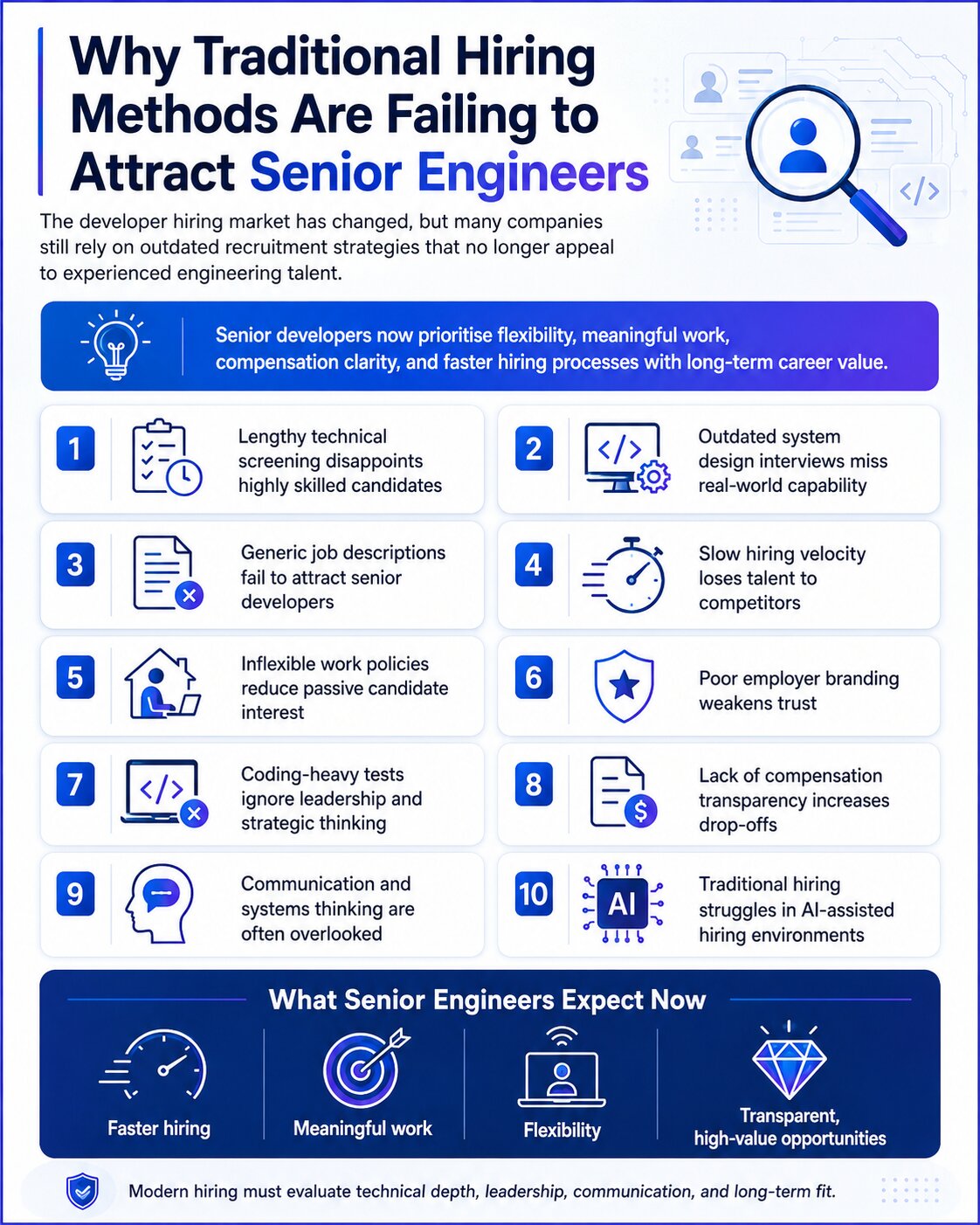
Why Are Traditional Hiring Methods Failing to Attract Senior Engineers?
How Has AI Changed Developer Hiring in 2026?
While going through the reasons why traditional hiring methods are not valid in 2026's hiring scenario, you might have come across the term "AI". With the introduction of automation and artificial intelligence, the software industry is running at an unprecedented pace. It is also reshaping how companies build, test, and maintain applications.
AI-assisted development tools have improved coding efficiency, leading to the high expectations that businesses have of modern engineering talent. Companies are no longer hiring developers only for writing code quickly.
Instead, organizations now prioritize professionals who can upskill themselves. They need to be able to adapt AI-generated workflows, review outputs critically, and make high-level technical decisions.
The following are the biggest hiring changes created by AI:
• Increased focus on engineering leadership skills and strategic problem-solving.
• A higher value is now being placed on architecture planning and scalability management.
• Higher importance of reviewing and validating AI-generated code.
• Reduced dependence on manual coding for repetitive development tasks.
• Increased need for developers who understand security, compliance, and risk management.
• Rising preference for engineers capable of integrating AI tools into existing workflows.
Why Are Senior Developers Becoming “Force Multipliers” In AI-Powered Teams?
Now that you know how AI has changed the hiring scenario, the next thing to consider is how experienced developers are becoming force multipliers. The reason is simple: AI has shifted the primary development bottleneck from coding speed to engineering judgment.
While AI-assisted tools can generate code faster, they cannot yet offer precise judgment. Companies still need skilled engineers to validate outputs, maintain software quality, and manage system scalability.
Such requirements have significantly increased the value of senior developers who have technical expertise and knowledge of systems thinking. They need to have strategic planning and leadership skills.
The following are ways senior developers are helping companies grow:
- Supervising the AI-generated workflows effectively.
- Reducing the production risks through stronger support systems.
- Enhancing the engineering scalability across large applications and teams.
- Identifying the architectural issues before they become a major concern.
- Accelerating development by improving the software quality.
- Helping and training junior developers to use AI tools effectively.
What Do Senior Developers Actually Want From Employers in 2026?
With the arrival of 2026, the priorities of senior developers have changed significantly. Experienced engineers are no longer attracted by compensation packages alone.
The fear of layoffs, burnout, unstable workloads, and rapid AI-driven industry changes has changed the perspective of developers in 2026. Understanding senior developer expectations has become essential for businesses competing for top engineering talent in 2026.
Experienced professionals now choose organizations that offer stability and meaningful technical challenges. They want a work culture that values flexibility and long-term career growth.
Senior developers choose organizations that value strategic decision-making, instead of focusing on productivity metrics or coding output. The following are the biggest expectations senior developers now have from employers:
- Preference for competitive and transparent compensation structures.
- Offering flexible remote or hybrid work environments.
- Companies that prioritize faster and more efficient hiring processes.
- Organizations that work on meaningful projects for long-term impact.
- Businesses that value a strong engineering culture and leadership support.
- Employees who offer strong opportunities to work with modern AI-assisted technologies.
- Firms that practice realistic workloads and a healthier work-life balance.
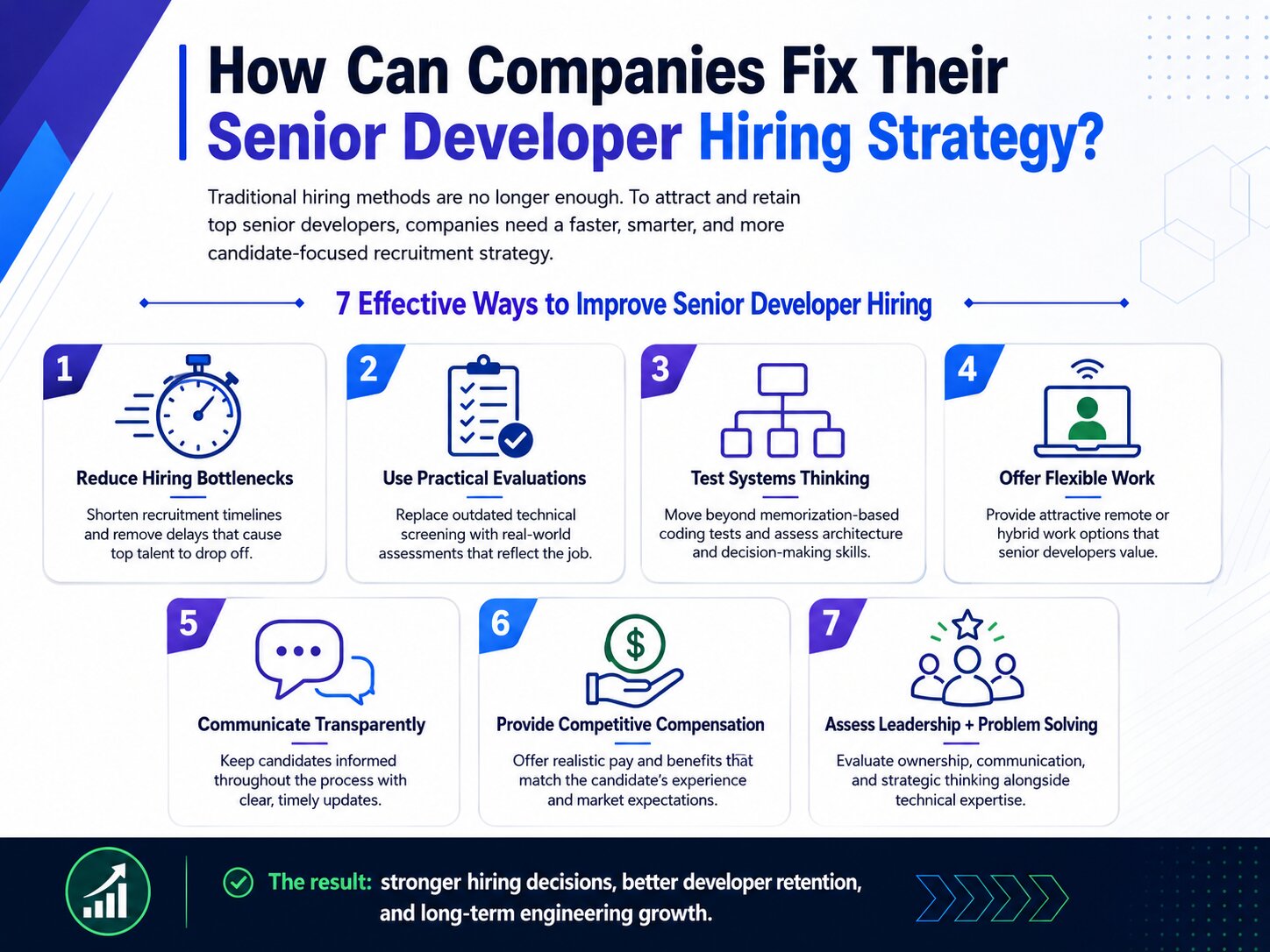
How Can Companies Fix Their Senior Developer Hiring Strategy?
What Will the Senior Developer Market Look Like Beyond 2026?
For an employer, successfully hiring expert candidates brings value and potential growth to the company. In this regard, they need to be well aware of the changing trends in the near future.
The demand for experienced senior developers is expected to grow even further beyond 2026. The reason for the growth can be attributed to the businesses continuing to expand their digital infrastructure and AI capabilities.
Companies now want capable candidates who can handle advanced engineering teams, manage automation, cloud systems, and cybersecurity. As AI continues to automate repetitive coding tasks, organizations will hire professionals who can combine technical expertise with systems thinking.
The following are the trends that are likely to shape the future of senior developer hiring beyond 2026:
- Companies will have greater reliance on AI-assisted engineering workflows.
- Increased demand for software architect hiring and scalability.
- Businesses will focus on developer retention and engineering culture.
- Rising competition for passive senior candidates
- Enhanced the value of leadership and cross-functional collaboration.
- Higher demand for cybersecurity and cloud infrastructure expertise.
- Higher emphasis on strategic thinking over repetitive coding tasks.
Find Skilled Senior Developers in 2026 with the Help of Tech Disciples
The demand for experienced engineering talent continues to rise as businesses compete for professionals with systems thinking, expertise, and leadership capabilities. It is a fact that in the current market, companies are no longer hiring developers based only on coding expertise.
Modern organizations now require senior engineers who can manage AI-assisted workflows and support the long-term growth goals of the company. In this regard, learning why it is hard to find senior developers in 2026 will be a step toward building a stronger hiring strategy.
At Tech Disciples LLC, we can make the process simpler. We help businesses connect with highly skilled technology professionals across multiple engineering domains. Our team focuses on offering you the ideal salary guide for modern tech recruitment, proactive strategies, and global talent accessibility.
Build a stronger and future-ready engineering team with the right technical talent from Tech Disciples.